Australian wages and wealth since 2000: why higher pay has not gone as far
Average full-time ordinary-time earnings reached $2,051 a week in November 2025, up 157% since 2000. After inflation, the real gain in purchasing power is much smaller, at around 15% to 20%.
12 min read 03 June 2026Updated 02 July 2026 Fact checked
Key figures
$2,051
Average weekly earnings (OTE), full-time adults, November 2025
$1,887
Median weekly earnings, all full-time workers, total earnings, May 2025
157%
Nominal wage growth since November 2000, full-time ordinary time earnings
−4.4%
Real wage decline in 2022, the largest single-year contraction in the available series
The average full-time Australian worker earned $2,051.10 a week in ordinary-time wages in November 2025, equal to $106,657 a year. That was 157% higher than in November 2000, when the same measure was $798.10 a week. In cash terms, full-time wages have more than doubled over 25 years.
Estimated real household income in 2026 sits roughly near its 2018 level, based on WPI and CPI movements rather than direct household income survey observations. After inflation, the gains from higher wages look much smaller. Much of the improvement built up through the 2010s was squeezed during the recent inflation surge, particularly in 2022, when consumer prices rose by 7.8% while wages increased by only 3.4%.
Section 01Average wages by year
Average wage in Australia by year, 2000–2025
What is the average full-time wage in Australia?
Full-time adult ordinary-time earnings averaged $2,051.10 a week in November 2025, equal to $106,657 a year. This figure is the mean, not the median. The median for all full-time workers was $1,887 a week, or $98,124 a year, in May 2025. The mean is higher because a relatively small number of very high earners lift the overall average.
Average Weekly Ordinary Time Earnings, or AWOTE, measures base pay for full-time adult employees. It excludes overtime, bonuses and one-off payments. Because the measure is used consistently across each survey period, it is one of the clearest ways to track changes in full-time base pay over time. The figures below use November readings, the main reference point for this series.
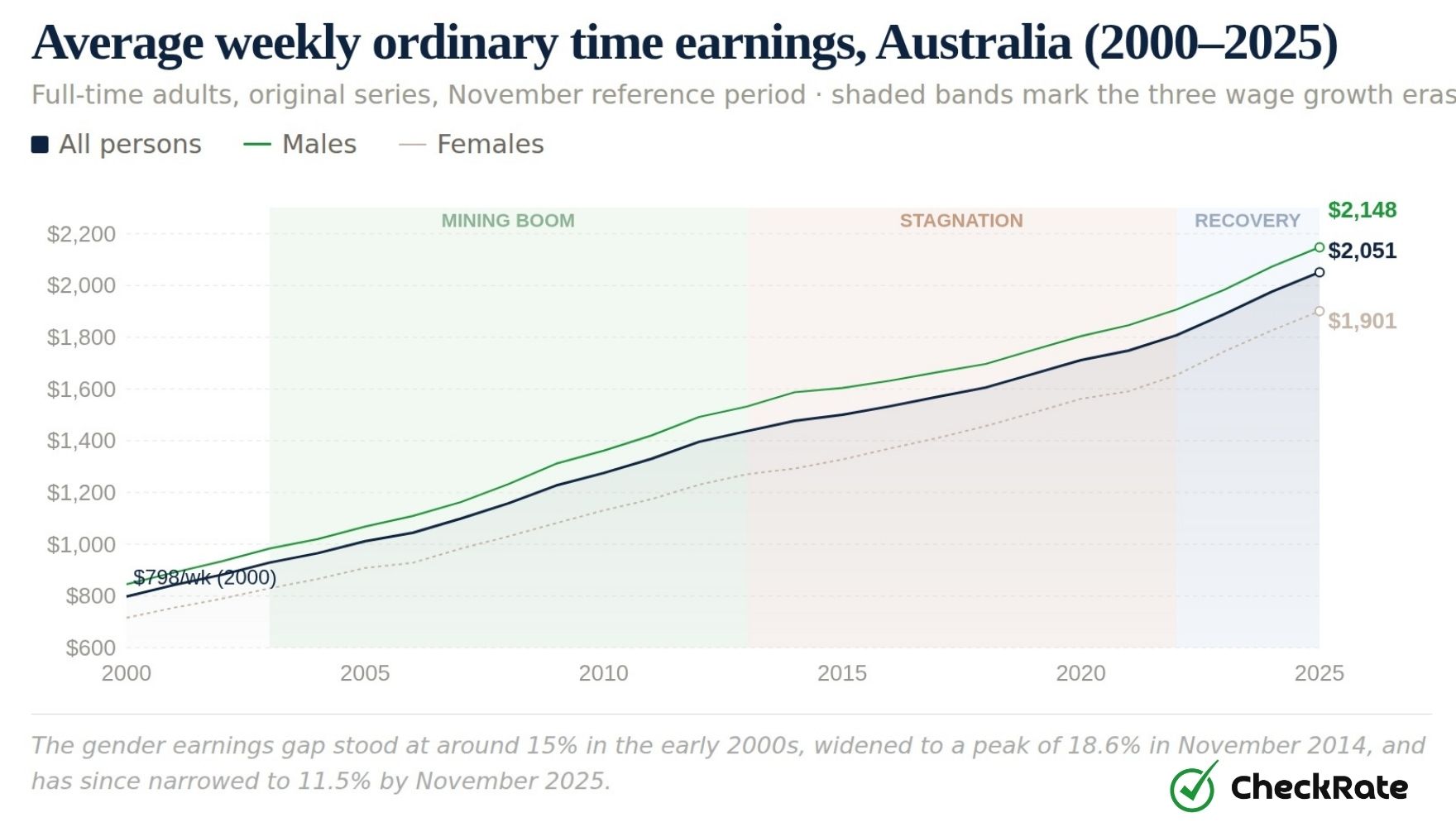
Three broad phases stand out across the 25 years. Wages grew strongly through the 2000s, helped by the mining investment boom and stronger competition for workers. Growth then slowed from 2013, averaging just 2.2% a year through to 2021. After the pandemic, a tighter labour market pushed nominal wage growth to its fastest pace since 2008. The Wage Price Index peaked at 4.2% in the December 2023 quarter, then eased to 3.3% by early 2026.
Average weekly ordinary time earnings, Australia (2000–2025)
Full-time adults, original series, November reference period. Mean weekly earnings in dollars. Shaded bands mark the three wage growth eras.
All personsMalesFemales
Background shading marks three eras: the mining-driven growth period (2003–2012), the prolonged stagnation (2013–2021), and the post-pandemic acceleration. The gender earnings gap stood at around 15% in the early 2000s, widened to a peak of 18.6% in November 2014, and has since narrowed to 11.5% by November 2025.
Source: ABS Average Weekly Earnings, Australia (Cat. 6302.0), Table 3, original series.
Gender pay gap in Australia: male and female earnings compared
Male full-time ordinary-time earnings were $2,147.80 a week in November 2025, compared with $1,900.60 a week for females. This puts the unadjusted gender pay gap at 11.5%, the narrowest recorded in the available series and down from a peak of 18.6% in November 2014.
This figure does not adjust for occupation, industry, seniority or hours worked. It should therefore be read as a whole-of-workforce comparison, rather than a like-for-like measure of pay for the same roles.
Full-time ordinary time earnings by gender
November 2025
200020052010201520202025
Weekly earnings, full-time adults, November 2025. Bars show earnings relative to the male figure as 100%.
Males
$2147.80 / wk
$111,686 / yr
11.5% gap
Females
$1900.60 / wk
$98,831 / yr
All persons
$2051.10 / wk
$106,657 / yr
The unadjusted gender earnings gap in November 2025 was 11.5%. Female full-time earnings were $1900.60/wk against $2147.80/wk for males.
Source: ABS Average Weekly Earnings, Australia (Cat. 6302.0), Table 3, original series, November readings.
What is the current average full-time wage in Australia?+
Full-time adult ordinary-time earnings, or AWOTE, averaged $2,051.10 a week in November 2025, equal to $106,657 a year. This is the mean, not the median. The median for full-time workers was $1,887 a week, or $98,124 a year, in May 2025.
What is AWOTE and how does it differ from an average salary?+
AWOTE stands for Average Weekly Ordinary Time Earnings. It covers base pay for full-time adults, excluding overtime, commissions, and bonuses, and is collected from employers each survey period. Average salary figures in the media often include part-time workers, use different pay components, or draw on different datasets entirely.
Why does the ABS report different average wage figures?+
Different ABS wage surveys measure different groups of workers. The AWOTE series covers full-time adult ordinary-time earnings only, which usually produces a higher average figure. Other employee earnings data can include part-time and casual workers, which often produces a lower median.
Section 02How earnings are distributed
Mean vs median wage in Australia: why the typical worker earns less than the average
The mean for full-time adult ordinary-time earnings was $2,051.10 a week in November 2025. The median for full-time workers was $1,887 a week in May 2025.
These figures come from different survey periods and measure slightly different things: ordinary-time earnings compared with total cash earnings. Even so, they point to the same broader pattern. A relatively small number of very high earners lift the mean above what a typical full-time worker receives.
Mean — full-time adults
Ordinary time, Nov 2025
$2,051
per week · pulled up by high earners
vs
midpoint
Median — all full-time workers
Total earnings, May 2025
$1,887
per week · half earn more, half less
When part-time workers are included, the median falls considerably. The all-employees median was $1,436 per week, or $74,672 per year, in May 2025. That was $451 below the full-time median.
This broader figure is often more useful for understanding earnings across the overall workforce because it includes full-time, part-time and casual workers.
Where full-time wages sit in Australia
One quarter of full-time workers earn below $1,424 per week. One quarter earn above $2,560 per week. The remaining half sit between those two points, with the median at $1,887.
Lower 25%
$1,424
per week · full-time
$74,048 per year. One in four full-time workers earns at or below this level. May 2025.
Median midpoint
$1,887
per week · full-time
$98,124 per year. The true midpoint of the full-time distribution. May 2025.
Upper 25%
$2,560
per week · full-time
$133,120 per year. One in four full-time workers earns at or above this level. May 2025.
Earnings range: Q1 to Q3 by worker type (May 2025)
Total cash earnings. Shaded bar = interquartile range (Q1 to Q3). Vertical line = median. Scale: $0 to $3,000/week.
Earnings range (Q1 → Q3)
Q1
Median
Q3
Full-time males
$1,472
$1,994
$2,741
Full-time females
$1,370
$1,758
$2,353
All full-time
$1,424
$1,887
$2,560
All persons
$878
$1,436
$2,122
Part-time only
$393
$769
$1,169
Each row uses the same $3,000 weekly scale, making part-time and full-time ranges directly comparable. The interquartile range spans $776/wk for part-time and $1,136/wk for all full-time workers.
Source: ABS Average Weekly Earnings, Australia (Cat. 6302.0), distribution of weekly total cash earnings, May 2025.
How the distribution has shifted since 2012
Between May 2021 and May 2025, the full-time median wage rose 18.5%, from $1,592 to $1,887 a week, as wage growth accelerated after the pandemic. Over the longer period since 2012, the gap between lower and upper full-time earners also widened. The interquartile range increased from $796 to $1,136 a week, meaning the dollar gap between the lower and upper quartile points grew by $340.
In percentage terms, however, the lower quartile point rose slightly faster than the upper quartile point, increasing by 53.4% compared with 48.5%.
Full-time earnings distribution by survey period
All full-time persons, total cash earnings per week. IQR = interquartile range (Q3 minus Q1).
Survey period
Q1 (25th pct)
Median
Q3 (75th pct)
IQR spread
May 2012
$928
$1,250
$1,724
$796
May 2016
$1,038
$1,398
$1,923
$885
May 2021
$1,196
$1,592
$2,192
$996
May 2023
$1,289
$1,710
$2,367
$1,078
May 2025 Current
$1,424
$1,887
$2,560
$1,136
The full-time median grew by 51.0% between May 2012 and May 2025. The interquartile range widened from $796 to $1,136 per week over the same period.
Source: ABS Average Weekly Earnings, Australia (Cat. 6302.0), distribution of weekly total cash earnings.
What is the median wage in Australia in 2026?+
The latest available data shows full-time workers had median total cash earnings of $1,887 a week, or $98,124 a year, in May 2025. For all employees, including part-time and casual workers, the median was lower at $1,436 a week, or $74,672 a year.
What percentage of Australians earn more than $100,000 per year?+
The available distribution data does not give an exact percentage. In May 2025, the full-time median was $1,887 a week, or $98,124 a year, while the third quartile was $2,560 a week, or $133,120 a year. A salary of $100,000 a year sits just above the full-time median.
Why is the mean higher than the median for Australian wages?+
The mean is calculated by adding all wages and dividing by the number of workers. It is pulled higher by a smaller group of very high earners, including senior executives, specialist professionals and high earners in sectors such as finance, mining and medicine. The median is the middle value, meaning half of workers earn more and half earn less.
Section 03Real income over time
Real income in Australia: how wages and purchasing power have changed
Estimated real household income in 2026 sits roughly near its 2018 level, based on WPI and CPI movements rather than direct household income survey observations. This suggests much of the gain built up through the 2010s has been reversed. The difference between nominal and real income is important. Nominal wage growth measures how much more money workers receive in dollar terms. Real wage growth shows whether that money actually buys more after inflation.
Real median equivalised disposable household income peaked at around $1,228 a week in 2020, measured in constant 2023 dollars. This was partly lifted by pandemic-era government transfers. By 2023, it had fallen to about $1,152 a week, roughly back to 2016 levels.
−4.4%
Largest real wage decline on record, 2022
Wages (WPI) grew by 3.4% in 2022. Inflation (CPI) rose by 7.8%. The result was a real wage contraction of 4.4%, the largest single-year decline in the available series. Together with the 1.1% real wage decline in 2021, this two-year period sharply reduced the purchasing power gains built up between 2014 and 2020.
The broader household income data shows a similar pattern. Disposable incomes were affected by higher mortgage repayments, rising energy bills and services inflation that ran above headline CPI. While nominal wages have continued to grow, the higher price level created by the 2022 inflation surge has not unwound.
Has the average Australian wage kept up with inflation?+
In most years between 2000 and 2020, wages did rise faster than inflation, but the gains were usually modest, typically between 0.2% and 1.4% a year in real terms. From 2013, those gains narrowed to close to zero. During the 2022 inflation spike, wages fell clearly behind prices. Wage growth was 3.4%, while inflation reached 7.8%, producing a real wage decline of about 4.4%.
What is real wage growth and how is it different from nominal wage growth?+
Nominal wage growth is the percentage increase in wages from one year to the next. If wages rise from $1,000 to $1,030 a week, that is 3% nominal growth. Real wage growth adjusts for inflation. If wages rise by 3% but prices rise by 4%, real wage growth is about −1%.
Section 04The wage stagnation era
When did Australia's wage growth stall?
Australia's wage growth slowed sharply between 2013 and 2021.
The Wage Price Index (WPI) measures changes in wage rates for a fixed basket of jobs. This helps filter out the effects of promotions, changes in the mix of workers, overtime and bonuses. It is one of the clearest indicators of whether employers are paying more for the same work.
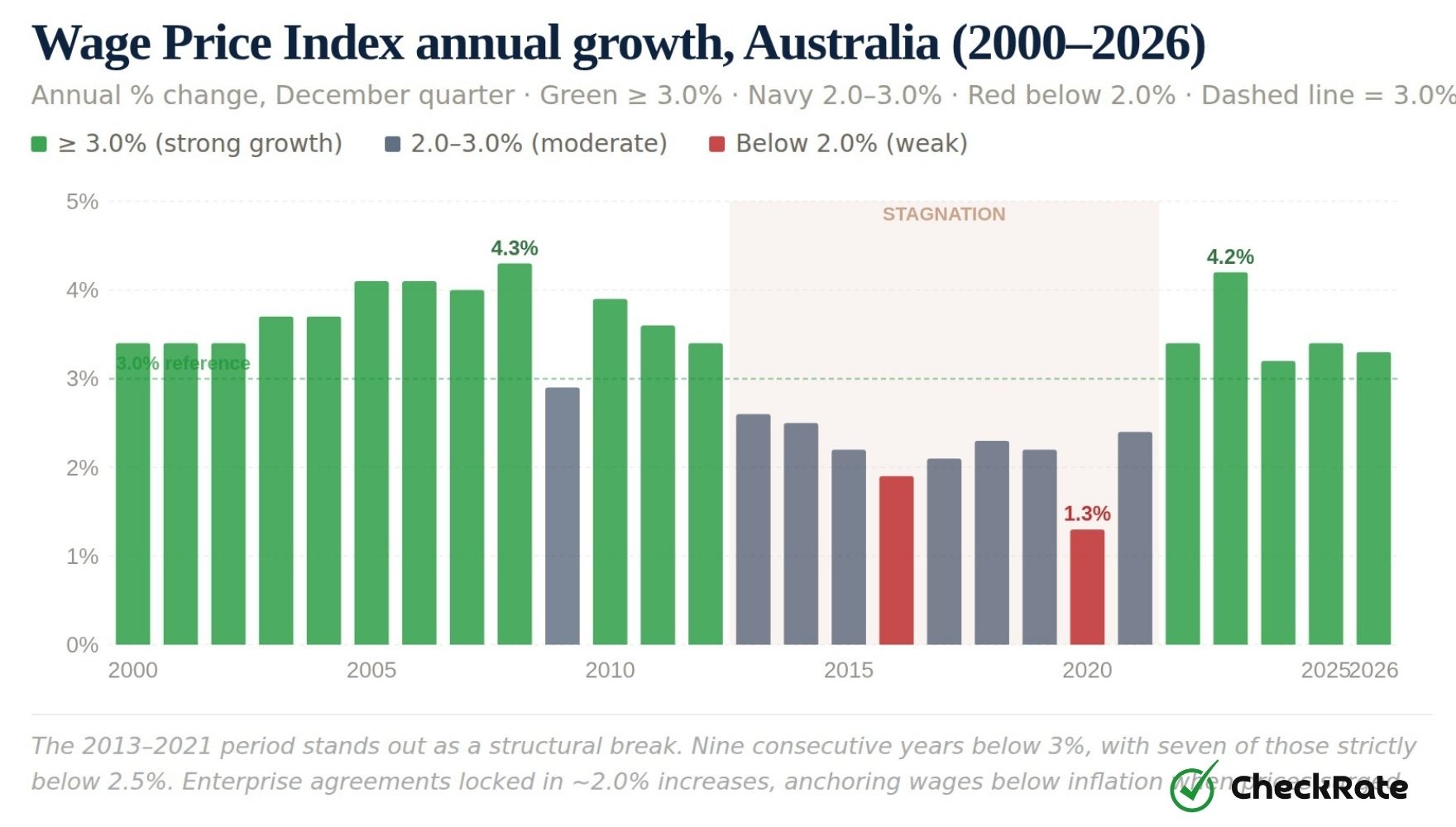
Annual WPI growth averaged 3.7% during the 2000s, but fell to an average of 2.2% between 2013 and 2021. It reached a record low of 1.3% in 2020, during the pandemic.
Growth era
2000–2012
3.7%
Avg annual WPI growth. Mining boom drives labour market tightness and strong base pay rises.
→
Stagnation
2013–2021
2.2%
Avg annual WPI growth. Fell to 1.3% in 2020, the weakest on record.
→
Post-pandemic
2022–2026
3.5%
Avg annual WPI growth. Peaked at 4.2% in December 2023; now easing to approx. 3.3%.
Wage Price Index annual growth, Australia (2000–2026)
Annual % change, December quarter. Green: at or above 3.0%. Navy: 2.0–3.0%. Red: below 2.0%. Dashed line marks the 3.0% reference. Shaded band = stagnation era.
3.0% and above2.0–3.0%Below 2.0%
The 2013 to 2021 period stands out as a structural break. Nine consecutive years below 3%, with seven of those strictly below 2.5%. Enterprise agreements from this era frequently locked in fixed increases around 2.0%, anchoring wages below inflation when prices eventually surged.
Source: ABS Wage Price Index, Australia (Cat. 6345.0), December quarter annual growth.
The slowdown coincided with several pressures. The capital-intensive phase of the mining boom ended, labour underutilisation rose as more workers wanted extra hours they could not get, and many enterprise bargaining agreements locked in fixed wage increases of around 2.0%. Weak productivity growth also weighed on pay growth.
These pressures did not resolve quickly. As a result, low wage growth persisted for several years and left workers more exposed when inflation surged.
The rebound from 2022 was influenced by a much tighter labour market. Border closures had reduced migrant labour supply, expired enterprise agreements were renegotiated at higher rates, and the Fair Work Commission approved larger minimum wage increases.
Annual WPI growth peaked at 4.2% in the December 2023 quarter before easing to about 3.3% by early 2026, as higher interest rates cooled hiring demand.
Why did Australian wage growth stall from 2013 to 2021?+
Australian wage growth stalled as several structural pressures converged. The capital-intensive phase of the mining boom ended, reducing its wider effect on the labour market. Labour underutilisation also rose, with more Australians working fewer hours than they wanted, which weakened bargaining power. At the same time, many enterprise agreements from the mid-2010s locked in fixed annual increases of around 2.0%, while declining union density made it harder to renegotiate higher increases.
What caused wages to rise again from 2022 onwards?+
Wages began rising again from 2022 as the post-pandemic labour market tightened sharply. Unemployment fell to multi-decade lows, border closures constrained migrant labour supply, and workers gained bargaining power they had lacked for much of the previous decade. WPI growth peaked at 4.2% in the December 2023 quarter before easing to about 3.3% by early 2026.
Section 05Wages and wealth
House prices vs wages in Australia: how the gap has widened
In 2000, the median Australian dwelling cost about 4.6 times the average annual full-time wage. By early 2026, that ratio had risen to more than 10 times.
Over the same period, nominal wages increased by 157%, but dwelling values rose much faster. This widened the gap between what full-time workers earn and what it costs to buy a home.
Median dwelling value to average annual wages ratio (2000–2026)
Ratio of estimated national median dwelling value to annualised AWOTE. A higher ratio means a dwelling costs more relative to wages. Dashed line marks the 2000 starting point.
Three distinct phases of acceleration are visible: 2001 to 2004 (credit availability and capital gains tax changes), 2013 to 2017 (record low interest rates during the wage stagnation era), and 2020 to 2022 (pandemic monetary and fiscal stimulus). Each phase lifted the ratio to a new floor from which it has not retreated.
Source: Cotality/CoreLogic national dwelling value data; ABS Average Weekly Earnings (Cat. 6302.0). Values before the direct Cotality/CoreLogic series are article-modelled estimates, retrojected using a long-run 6.8% annual growth assumption.
Ratio in 2000
4.6×
Dwelling value relative to annual full-time wages
Ratio in 2015
6.6×
After the low-rate era accelerated the divergence
Ratio in 2026
10.1×
More than double the 2000 level
How long does it take to save a deposit on a house on the average wage?+
On the average full-time wage of $106,657 a year, saving 20% of gross income would amount to $21,331 a year. At that rate, saving a 20% deposit on a median-priced Australian dwelling would take about 10 years in 2026. In 2000, using the same savings rate, it would have taken roughly 4.5 years.
Why have dwelling values grown faster than wages?+
Tax settings, including negative gearing and the capital gains tax discount, have made property investment more attractive. Historically low interest rates between 2011 and 2022 also increased borrowing capacity without a matching lift in wages. At the same time, restrictive land-use planning in major cities limited how quickly new housing could be added as the population grew.
Section 06Housing affordability
Australia's dwelling price-to-income ratio has doubled since 2000
The dwelling price-to-income ratio measures how many years of median gross household income would be needed to buy a median-priced dwelling outright. In 2000, the ratio stood at 4.2, which was already high by historical standards. By 2024, it had reached a peak of 8.6, meaning a median-priced home cost more than twice as much relative to household income as it did 24 years earlier.
8.6×
Dwelling price-to-income ratio, 2024 peak
A median-priced dwelling in 2024 required the equivalent of 8.6 years of median gross household income, up from 4.2 in 2000. For a household saving 15% of gross income towards a 20% deposit, that accumulation period extends to roughly 10 to 11 years.
The ratio eased slightly to about 8.3 to 8.4 in 2025 and 2026, as higher interest rates cooled price growth in parts of the market. But this does not necessarily mean housing became more affordable. The easing mainly reflects reduced borrowing capacity, while dwelling prices remain high, the deposit hurdle is still substantial, and mortgage repayments are a heavier burden than they were before interest rates rose.
What does the dwelling price-to-income ratio mean in practice?+
The ratio shows how many years of total household income would be needed to buy a median-priced dwelling outright, assuming no other spending. A ratio of 8.6 means a household on the national median income would need to put every dollar of income towards a home for 8.6 years to cover the purchase price.
Has housing affordability improved since the rate rises of 2022?+
Only at the margins. The rate rises from 2022 to 2024 reduced borrowing capacity by increasing repayment costs, which cooled demand in parts of the market and moderated price growth. The dwelling price-to-income ratio eased from a peak of 8.6 in 2024 to about 8.3 to 8.4 in 2025 and 2026.
Section 07OECD comparison
How Australia compares to other OECD countries over time
Australia's nominal house price-to-income index reached 130 in 2024, one of the higher readings among countries in the Organisation for Economic Co-operation and Development (OECD), before easing to about 128 in early 2026.
The index is standardised at 100 in 2015 across member countries and measures how much house prices have grown relative to disposable income since that base year.
A reading of 128 means Australian house prices have grown about 28% faster than disposable incomes since 2015.
OECD nominal house price-to-income index, Australia (2000–2026)
Index = 100 at the 2015 base year. A rising index means housing prices are growing faster than disposable income. Dashed line marks the 2015 baseline.
The most significant feature of Australia's trajectory is what did not happen after 2008: while the US, Spain, and Ireland experienced sharp index corrections, Australia's index held near its pre-crisis level and resumed its ascent. That uninterrupted compounding off a high base is the key reason Australia sits at the upper end of the OECD distribution on this measure.
Source: OECD Housing Affordability Dataset, nominal house price-to-income index, base year 2015 = 100, seasonally adjusted. 2026 figure is a Q1 estimate.
OECD index, 2000
65.0
Australia's starting point, already elevated before the major run-up
OECD base year, 2015
100.0
All OECD countries anchored at 100 for comparability
OECD index, 2026 (est.)
128.0
Prices grew 28% faster than incomes since 2015 alone
How does Australia's housing affordability compare internationally?+
Australia's price-to-income index reached 130 in 2024 and sat at about 128 in early 2026, placing it among the higher readings for OECD countries. The OECD average has risen more moderately over the same period. Australia's key difference is not only the level of the index, but its long-term path — it has risen almost continuously since 2000, without the larger corrections seen in some peer countries after 2008.
What does an OECD index value of 128 mean in plain terms?+
An index value of 128 means that, compared with 2015, Australian house prices have grown about 28% faster than disposable incomes. If house prices and disposable incomes had grown at the same rate since 2015, the index would still be 100.
Section 08Real purchasing power
Australian purchasing power since 2000: are workers better off?
Has purchasing power improved since 2000?
From 2000 to 2012, yes. The Wage Price Index outpaced inflation in every year, producing modest but consistent gains in real wages. From 2013, those gains narrowed to close to zero, with WPI growth averaging 2.2% a year while inflation moved at a similar pace. In 2021 and 2022, real wages fell by a combined 5.5 percentage points, wiping out the gains built up over the previous seven years. By early 2026, WPI growth was again running below inflation, at 3.3% compared with 4.6% for CPI.
Real wage growth is calculated as the annual Wage Price Index minus the Consumer Price Index. A positive result means wages outpaced prices that year. A negative result means purchasing power fell.
+3.2%
WPI-minus-CPI estimate, 2014 to 2020
Seven years of marginal but consistent gains averaging under 0.5% per year, compounding slowly.
−5.5%
percentage points Combined WPI-minus-CPI loss, 2021 and 2022
Two years completely erased the preceding seven years of gains.
Annual real wage growth, Australia (2000–2026)
Wage Price Index minus CPI (%), December quarter. Green: purchasing power gained. Red: purchasing power lost. 2026 is a preliminary Q1 estimate. Shaded band = stagnation era.
Positive real growthNegative real growth2022 record decline
The 2022 bar (−4.4%) is the defining feature of the modern Australian wage story. That single year inflicted more damage to real purchasing power than all the marginal gains of the 2013 to 2020 stagnation era. The partial recoveries of 2023 (+0.1%) and 2024 (+0.8%) were set against a higher price floor, not a restoration of pre-2021 purchasing power.
Source: ABS Wage Price Index (Cat. 6345.0) and Consumer Price Index (Cat. 6401.0), December quarter. 2026 based on Q1 preliminary release.
In nominal terms, average wages have grown by 157% since 2000. In real purchasing power terms, the gain is far more modest. Between 2000 and 2012, real wages grew by 0.6% to 1.4% a year, compounding into a meaningful lift in living standards. From 2014 to 2020, growth averaged less than 0.5% a year.
The contraction in 2021 and 2022 then reversed those gains. Even with a partial recovery in 2023 (+0.1%) and 2024 (+0.8%), real wages in 2026 sit close to where they were in 2009. The higher price level created by the 2022 inflation surge remains the new baseline, even as wage growth continues.
About the data
These figures use the Wage Price Index (a fixed-basket measure of base pay) minus the headline CPI. The WPI excludes promotions, overtime, and bonuses. The CPI is a national average and may understate cost pressures on lower-income households, who spend a higher share of income on essentials. Results reflect broad trends across the workforce; individual outcomes vary significantly by occupation, industry, household structure, and whether the household owns property.
Have real wages increased since 2000?+
For wage earners, real wages appear higher than in 2000, but the increase is much smaller than the nominal wage rise. Between 2000 and 2020, real wages grew by roughly 15% to 20% in cumulative terms. The 2021 to 2022 inflation period erased much of that progress, with a combined real wage loss of 5.5% wiping out the gains built up over the previous seven years. By 2026, real wages sit close to where they were in 2009.
What caused the 2022 real wage decline?+
The 2022 real wage decline of 4.4% was caused by inflation running well ahead of wages. Consumer prices rose by 7.8% that year, driven by global supply chain disruption, energy price shocks following the Russia-Ukraine war, pandemic-era demand stimulus and rising housing costs. Wages grew by just 3.4% over the same period.
Has Australia recovered from the 2022 real wage decline?+
Only partially. In 2023 and 2024, inflation moderated, and wage growth picked up, producing small positive real wage outcomes of 0.1% and 0.8%, respectively. But these gains did not restore the purchasing power lost in 2021 and 2022. In early 2026, inflation was again running ahead of wage growth, with CPI at 4.6% compared with wage growth of 3.3%.
Explore wages and purchasing power since 2000
Interactive explorer
Explore wages and purchasing power since 2000
Two tools to explore the data. The year explorer shows how average earnings have changed in nominal and real terms from any starting point since 2000. The earnings position tool shows where a weekly or annual income sits in the May 2025 distribution.
November 2000
200020052010201520202025
AWOTE in 2000
$798.10
per week · $41,501 per year
Same wage in 2025 dollars
$1,556
per week · $80,927 per year
Nominal AWOTE growth 2000–2025
+157.0%
Change in actual weekly earnings
Real AWOTE growth 2000–2025
+31.8%
Wage gains above inflation since 2000
AWOTE from 2000 to 2025 ($/week, November readings)
General information only
This article draws on publicly available data from the ABS, CoreLogic, the OECD, and other government and research bodies. It is general information only and does not constitute financial, legal, or investment advice.
Wage and income figures reflect population-level data at specific points in time and may not represent individual circumstances. Earnings vary based on industry, occupation, employment type, location, qualifications, experience, and employer.
Real wage estimates for 2026 are based on preliminary data releases and are subject to revision. Housing affordability and dwelling value figures are derived from modelled datasets that carry inherent uncertainty, particularly for retrojected historical values. Before making financial or investment decisions based on any information in this article, consider seeking independent professional advice.
REFERENCES
1ABS Average Weekly Earnings, Australia (Cat. 6302.0): Table 3, original series. Used for AWOTE figures, including full-time adult ordinary-time earnings and total earnings. November reference periods are used for long-term wage comparisons.
4ABS Consumer Price Index, Australia (Cat. 6401.0): Annual percentage change, December quarter. Combined with WPI to derive real wage growth estimates. The 2026 figure reflects the Q1 preliminary release (CPI 4.6%).
6Cotality/CoreLogic national dwelling value data: Used for the dwelling value-to-wages ratio. Values before the direct Cotality/CoreLogic series are article-modelled estimates, retrojected using a long-run 6.8% annual growth assumption.
8OECD Housing Affordability Dataset: Nominal house price-to-income index, base year 2015 = 100, seasonally adjusted. The 2026 figure is a Q1 estimate based on recent OECD statistical releases.
Data Snapshots
Average Weekly Ordinary Time Earnings Australia Wage Price Index Annual Growth Australia