What is the average salary in Australia?
Full-time adult average weekly ordinary time earnings were $2,051.10 a week, or $106,657 a year, in November 2025. This is the main national benchmark for full-time adult earnings. It excludes overtime and is calculated as a mean, which means it can be lifted by higher earners.
Median weekly earnings in a main job were lower, at $1,425 a week, or $74,100 a year, in August 2025. That means the median sits $32,557 a year below the full-time adult average. The gap shows how higher earners can pull the mean above the middle of the earnings distribution.
The broader all-employees average was $1,562.40 a week, or $81,245 a year, in November 2025. This figure includes full-time, part-time and casual workers, so it sits below the full-time adult benchmark.
| Measure | Source and period | Weekly | Annual (est.) |
|---|---|---|---|
| Full-time adult average weekly ordinary time earnings | AWE, Nov 2025, persons, seasonally adjusted | $2,051.10 | $106,657 |
| Full-time adult average weekly total earnings (incl. overtime) | AWE, Nov 2025, persons, original | $2,129.00 | $110,708 |
| All employees average weekly total earnings | AWE, Nov 2025, persons, original | $1,562.40 | $81,245 |
| Median weekly earnings, main job | Employee Earnings, Aug 2025, persons | $1,425.00 | $74,100 |
| Median hourly earnings, main job | Employee Earnings, Aug 2025, persons | $42.90/hr | — |

Which occupations earn the highest salaries in Australia?
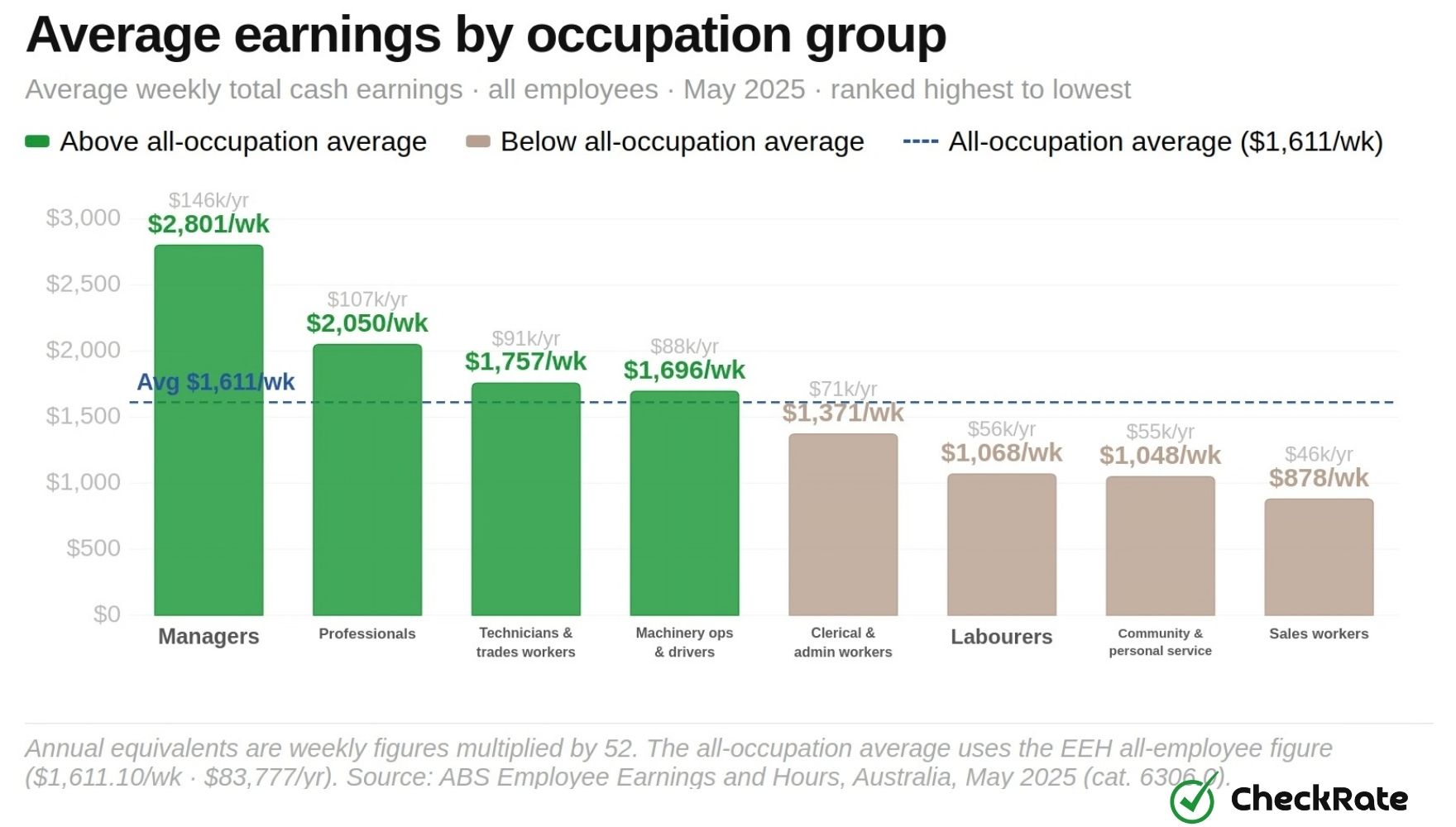
Managers averaged $2,800.90 a week or $145,647 a year in May 2025. This is the highest average earnings figure of any major occupation group. Sales workers averaged $878.20 a week or $45,666 a year, the lowest. The gap between the two groups was almost $100,000 a year.
Four of the eight major occupation groups sit above the all-occupation average of $1,611.10 a week. These are managers, professionals, technicians and trades workers, and machinery operators and drivers. Clerical and administrative workers, labourers, community and personal service workers, and sales workers are below the average.
Professionals are the largest group at 3.18 million employees, yet they earned $751.30 a week less than managers on average. Managers, at 1.27 million employees, are a considerably smaller group.
- Weekly earnings
Which occupations are the highest and lowest paid in Australia?
At the sub-major occupation level, the gap between the highest and lowest-paid groups is wider. Chief executives, general managers and legislators record the highest median weekly earnings, at $3,223 a week, or $167,596 a year. Food preparation assistants record the lowest, at $448 a week, or $23,296 a year. The difference between these two groups is $2,775 a week, or more than $144,000 a year.
All figures in this section are medians: half of workers in each group earn more than the stated amount, and half earn less.
Source: ABS Employee Earnings, Australia, August 2025 (cat. 6310.0). Figures are median weekly earnings in main job; annual equivalents are weekly multiplied by 52.
Several of the lowest-paid groups have a high share of part-time or casual workers, which can lower median weekly earnings even where hourly rates are award-regulated. This is most visible in food preparation, hospitality and retail, where shorter shifts and casual work are common.
Which industries have the highest average salaries in Australia?
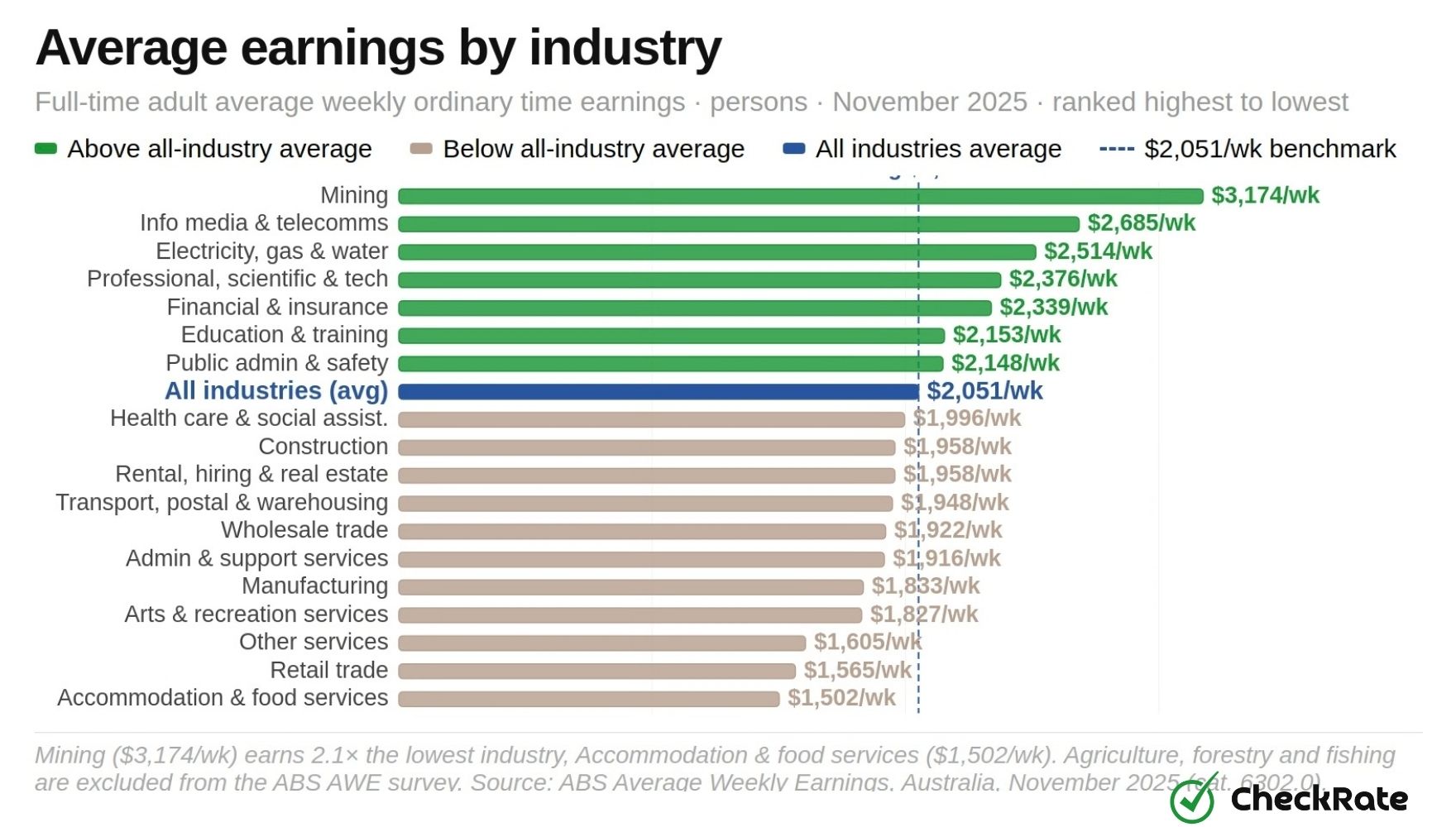
Industry can shape earnings as much as occupation. Mining workers averaged $3,174.40 a week in ordinary time earnings in November 2025, or $165,069 a year, more than double the accommodation and food services industry average of $1,501.60 a week ($78,083/yr). The gap between the highest and lowest-paying industries was about $87,000 a year.
The public sector averaged $2,215.90 a week on a full-time adult ordinary time basis in November 2025, compared with $2,006.00 a week in the private sector. That $209.90 weekly premium equates to about $10,915 a year.
One limit applies to the industry comparison: the Average Weekly Earnings survey excludes businesses engaged primarily in agriculture, forestry and fishing, so those industries do not appear in the ranking below.
How much more do full-time workers earn than part-time workers?
Employment type is associated with large differences in weekly earnings. In May 2025, full-time employees averaged $2,130.60 a week, while part-time employees averaged $873.00 a week. On this measure, full-time weekly earnings were 2.44 times part-time weekly earnings.
That ratio has narrowed slightly since June 2021. In May 2021, full-time earnings were 2.49 times part-time earnings. By May 2025, the ratio was 2.44 times.
Around 2.4 million employees were classified as casual in August 2025, accounting for 19% of all employees. Casual workers are more likely to work part-time, so their weekly earnings often reflect shorter hours as well as hourly rates.
- Full-time
- All employees
- Part-time
Which occupations have seen the fastest wage growth?
Labourers recorded the fastest growth in median hourly earnings of any major occupation group between August 2020 and August 2025, rising 21.7% over the five years, from $26.30 to $32.00 an hour. Clerical and administrative workers rose 21.1%, and community and personal service workers rose 20.6%.
At the sub-major level, arts and media professionals recorded the highest average annual growth in median weekly earnings between 2020 and 2025, at 7.9% per annum. This was the strongest published growth rate for any detailed occupation group over that period.
The overall pace of wage growth was 3.3% in the year to March 2026, as measured by the Wage Price Index. This was the slowest annual rate since 2022 and below the recent peak of 4.3% in late 2023. The three fastest-growing major groups, labourers, clerical and administrative workers, and community and personal service workers, still sit below the all-occupation average weekly earnings of $1,611.10.
Total wages and salaries paid by employers reached $110,560 million in March 2026, up 6.0% from the same month a year earlier, according to the Monthly Employee Earnings Indicator. This figure is higher than the 3.3% WPI reading because it captures both wage changes and changes in the size and composition of the workforce. The WPI measures wage movements for a fixed set of jobs only.
How does the gender pay gap differ by occupation in Australia?
Across all occupations, full-time non-managerial employees paid at the adult rate earned $2,185.50 a week for men and $1,888.70 a week for women in May 2025. That is a gap of $296.80 a week, or roughly $15,434 a year. On a male-earnings basis, the overall gap is 13.6%.
The gap varies by occupation group. Community and personal service workers had the widest gap at 23.5%, followed by technicians and trades workers at 22.9% and labourers at 21.5%. The narrowest gaps were in sales workers (8.6%), machinery operators and drivers (9.6%), and clerical and administrative workers (10.8%).
The historical picture shows some narrowing. Female full-time median weekly earnings rose from $800 a week in 2006 to $1,631 in 2025, a 103.9% increase. Male full-time median weekly earnings rose from $950 to $1,841, a 93.8% increase. As a result, female earnings as a share of male earnings improved from 84.2% in 2006 to 88.6% in 2025.
- Male (FT non-mgr, adult rate)
- Female (FT non-mgr, adult rate)
- Female full-time median
- Male full-time median
Why is the gender pay gap widest in community and personal service work?+
Does the overall AWE gender gap differ from the EEH figure?+
Is the gender pay gap closing?+
References
- Australian Bureau of Statistics. Average Weekly Earnings, Australia, November 2025 (cat. 6302.0). Released February 2026.
- Australian Bureau of Statistics. Employee Earnings and Hours, Australia, May 2025 (cat. 6306.0): occupation group earnings, full-time and part-time earnings, and gender pay gap by occupation.
- Australian Bureau of Statistics. Employee Earnings, Australia, August 2025 (cat. 6310.0): sub-major occupation medians, historical gender earnings, and hourly wage growth by occupation.
- Australian Bureau of Statistics. Wage Price Index, Australia, March quarter 2026 (cat. 6345.0): headline wage growth and WPI context.
- Australian Bureau of Statistics. Monthly Employee Earnings Indicator, March 2026: wages and salaries paid by employers in March 2026.
This article draws on five ABS releases. The national earnings benchmark uses Average Weekly Earnings (AWE), November 2025 (cat. 6302.0), which is published twice a year. Occupation-group earnings use Employee Earnings and Hours (EEH), May 2025 (cat. 6306.0), which provides detailed earnings and hours data by occupation, sex, employment status and other employee characteristics. Sub-major occupation medians and the historical gender earnings series use Employee Earnings, August 2025 (cat. 6310.0), published annually. Wage growth uses the Wage Price Index (WPI), March quarter 2026 (cat. 6345.0). Aggregate wages and salaries use the Monthly Employee Earnings Indicator, March 2026.
Occupation-group comparisons use figures from the same EEH release to avoid cross-survey mixing. Annual equivalents are weekly figures multiplied by 52 and are arithmetic estimates, not direct survey observations. The AWE survey excludes businesses engaged primarily in agriculture, forestry and fishing. As of June 2026, no official ABS occupation earnings release covers 2026. The next AWE release, covering May 2026, is scheduled for 19 August 2026.
ABS defines mean weekly earnings as average gross earnings. Median weekly earnings are the midpoint of the earnings distribution. AWE cash earnings include salary sacrifice, while EEH total cash earnings are gross earnings inclusive of salary sacrifice. These measures are not interchangeable and are identified in each table.
Data Snapshots