The average Australian employee earns an estimated $86,000 a year in early 2026. Data on earnings by age group, the gender pay gap, graduate salaries and superannuation balances across a working life.
12 min read 03 June 2026Updated 02 July 2026 Fact checked
Key statistics: Q1 2026 (projected)
$86,000
Projected national average annual earnings, all employees ($7,163/mth), Q1 2026
45–54
Peak earning age group: projected $2,031/wk ($8,801/mth · $105,600/yr)
3.22%
Annual wage growth in the year to March 2026 (Wage Price Index), easing from 4.1% in June 2024
14.6%
Gender pay gap at its widest, full-time workers aged 45 to 54 ($19,552/yr), May 2025
Section 01Earnings by age
Average earnings by age group in Australia
Australian employees earned an average of $1,611 per week in May 2025, or roughly $83,800 a year. This figure covers all employees, including full-time, part-time, permanent and casual workers across all industries and pay rates.
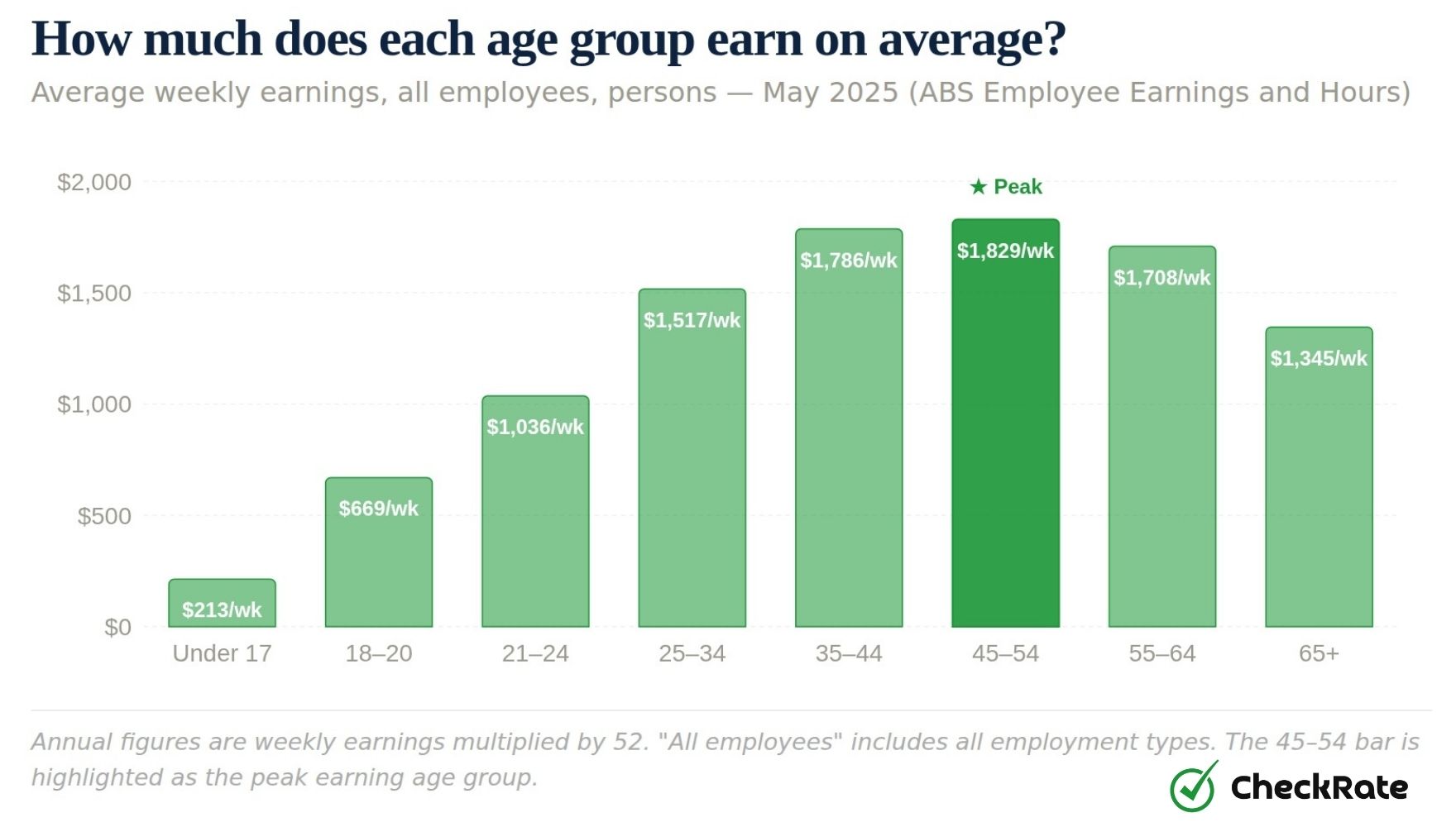
Earnings vary sharply by age. Workers aged 45 to 54 had the highest average earnings at $1,979 per week, or about $102,900 a year. Those aged 35 to 44 were close behind at $1,878 per week. Younger workers earned considerably less, with the 21 to 34 group averaging $1,412 per week and workers under 20 averaging $511 per week.
How much does each age group earn on average?
Average earnings, by age and employment type, May 2025
Annual figures are weekly × 52; monthly figures are weekly × 52 ÷ 12. 'All employees' includes all employment types (ABS EEH, table 4). 'Full-time only' covers full-time non-managerial employees paid at the adult rate (table 6). The 45–54 bar is highlighted as the peak earning age group.
Source: ABS Employee Earnings and Hours, Australia, May 2025, cubes 4 and 6. Released 23 January 2026.
Full earnings breakdown by age group (May 2025)
Age group
Median (wk)
FT avg (wk)
PT avg (wk)
All avg (wk)
Monthly
Annual
20 and under
$353
$1,111
$368
$511
$2,213
$26,600
21–34
$1,330
$1,831
$826
$1,412
$6,120
$73,400
35–44
$1,717
$2,310
$1,054
$1,878
$8,136
$97,600
45–54 ★
$1,732
$2,417
$1,090
$1,979
$8,575
$102,900
55+
$1,480
$2,224
$995
$1,711
$7,416
$89,000
All ages
$1,436
$2,131
$873
$1,611
$6,981
$83,800
Source: ABS Employee Earnings and Hours, Australia, May 2025. ★ = peak earning age group.
Full-time workers earn considerably more than part-time workers in every age group, largely because they work longer hours and are less concentrated in lower-paid industries. Median earnings give a clearer picture of what a typical worker receives — averages are pulled higher by top earners.
How pay is set changes with age
Around 61% of employees aged under 17 are paid junior or award rates, compared with about 23% nationally. As workers get older, pay is more likely to be set through individual arrangements that can include higher base pay, bonuses and performance incentives. This helps explain why earnings rise sharply between the 21 to 24 and 25 to 34 age groups. Location also plays a role: workers in Western Australia earn a median of $1,484 per week, compared with $1,319 per week in South Australia.
Section 02Q1 2026 projection
What do Australian workers earn in 2026?
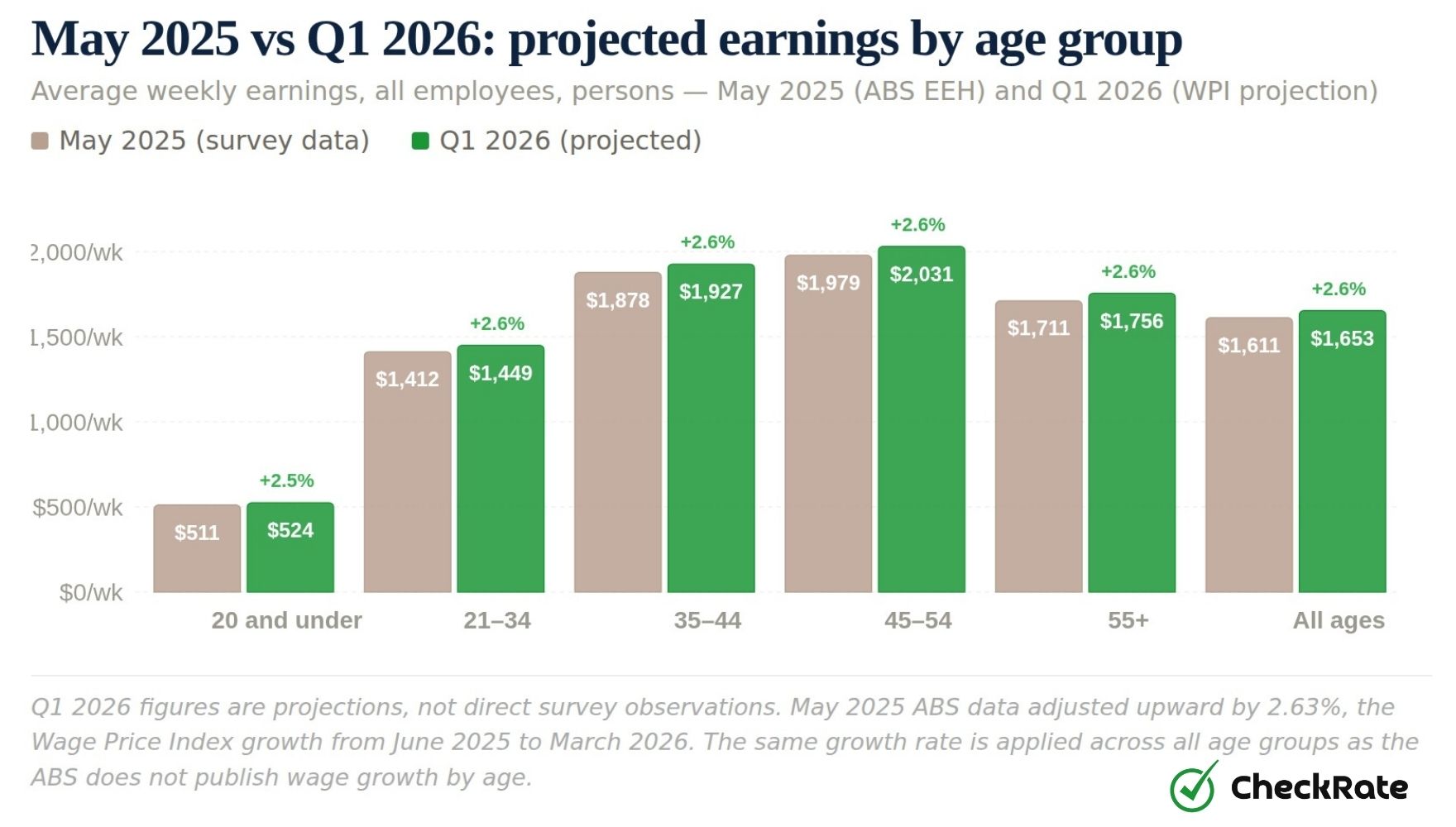
Australian employees are estimated to earn an average of $1,653 per week in Q1 2026, or roughly $86,000 a year. Earnings remain highest for workers aged 45 to 54, at $2,031 per week, or about $105,600 a year.
At the lower end, workers under 20 average an estimated $524 per week, or about $27,300 a year. Among full-time non-managerial employees, the 45 to 54 age group reaches $2,314 per week or about $120,300 a year.
These are projected estimates, not direct survey results. The ABS Employee Earnings and Hours survey runs every two years; May 2025 results have been updated using the Wage Price Index (WPI), which rose by 2.63 per cent from June 2025 to March 2026.
May 2025 vs Q1 2026: projected earnings by age group
Average weekly earnings, all employees, persons (ABS EEH; WPI projection)
May 2025
Q1 2026 (proj)
Q1 2026 figures are projections, not direct survey observations. The same 2.63% WPI growth rate has been applied across all age groups.
Source: ABS Employee Earnings and Hours, May 2025 (cat. 6306.0); ABS Wage Price Index, March quarter 2026 (cat. 6345.0, series A2603609J).
May 2025 vs Q1 2026 projected — full table
Age group
May 2025 (wk)
May 2025 (annual)
Q1 2026 (wk)
Q1 2026 (annual)
Change
20 and under
$511
$26,600
$524
$27,300
+2.5%
21–34
$1,412
$73,400
$1,449
$75,400
+2.6%
35–44
$1,878
$97,600
$1,927
$100,200
+2.6%
45–54 ★
$1,979
$102,900
$2,031
$105,600
+2.6%
55+
$1,711
$89,000
$1,756
$91,300
+2.6%
Source: ABS EEH, May 2025 + ABS WPI, March quarter 2026 projection.
Wage growth, as measured by the WPI, cooled to 3.22 per cent in the year to March 2026, down from 4.1 per cent in the year to June 2024. That is the slowest annual pace since 2022, although still above the pre-COVID average of around 2% to 2.5%.
Wage growth in Australia by quarter, 2010–2026
Year-on-year WPI growth (%), quarterly data. Total hourly rates of pay excluding bonuses, all industries
The dashed line marks the 2014–2019 pre-pandemic average of approximately 2.2%. Growth peaked at 4.26% in Q4 2023 and has since eased to 3.22% in Q1 2026.
Source: ABS Wage Price Index, Australia (cat. 6345.0).
3.22%
Annual wage growth, year to March 2026. The slowest pace since 2022, down from a peak of 4.1% in June 2024.
+2.63%
Wage growth applied to project Q1 2026 earnings, based on WPI changes between June 2025 and March 2026.
1.35%
Lowest wage growth recorded during COVID (year to September 2020). Current growth remains above the pre-COVID 2–2.5% average.
About the data
The Q1 2026 earnings figures are projections, not direct survey observations. The same wage growth rate has been applied to all age groups, as the ABS does not publish separate wage growth figures by age. The WPI tracks a fixed set of jobs and excludes bonuses, so projections may slightly understate actual earnings growth. Direct age-by-age 2026 data will be available when the ABS releases the May 2027 EEH survey.
Section 03Peak earnings
At what age do Australians reach peak earnings?
Workers aged 45 to 54 have been Australia's highest-earning age group in every national earnings survey since at least 2018. In May 2025, this group averaged $1,979 per week across all employees, or $102,900 a year. Among full-time employees, the average was $2,417 per week, or $125,700 a year.
Pay generally rises through a worker's 20s and 30s as experience builds and people move into more senior roles. It then levels off in the 45 to 54 age group before falling by around 14% for workers aged 55 and over — partly reflecting older workers moving into part-time arrangements.
Average weekly earnings increased by around 25% in the seven years to May 2025. Workers under 20 recorded the fastest growth, rising 33.1% from $384 to $511 per week. Among adult age groups, workers aged 21 to 34 recorded the strongest recent growth, rising 9.5% from $1,289 to $1,412 per week between 2023 and 2025.
Earnings have risen across all age groups since 2018
Average weekly earnings by age group, all employees, persons, May 2018 to Q1 2026 (projected)
20 and under
21–34
35–44
45–54 (peak)
55+
The 45–54 group has been the highest-earning age band in all survey periods shown. The Q1 2026 point is a Wage Price Index projection. Under-20 earnings grew fastest (+36.6%).
Source: ABS Employee Earnings and Hours, cube 1, table 2 (persons, all employees). Q1 2026 projection via ABS WPI.
+36.6%
Earnings growth for workers under 20 (May 2018 → Q1 2026 projected): the fastest of any age group, partly reflecting minimum wage and junior pay increases.
45–54
Australia's highest-earning age group in every national earnings survey since 2018, projected at $8,801/month in Q1 2026.
+9.5%
Earnings growth for the 21 to 34 age group over the two years to May 2025: the fastest of any adult group in that period.
Section 04Gender pay gap
How much does the gender pay gap vary by age?
Among full-time employees, the gender pay gap is narrowest for younger workers and widens through mid-career. Workers under 20 had a gap of 3.3% in May 2025, with male full-time employees averaging $1,121 per week compared with $1,084 for females — a difference of about $1,924 a year.
By the 35 to 44 age group, that gap had widened to 14.0%, equal to $341 per week or $17,732 a year. It peaked in the 45 to 54 age group at 14.6%, or $376 per week and $19,552 a year.
Part of this reflects differences in occupation, seniority, industry and working patterns. The widening from early to mid-career is also consistent with research on the "child penalty", where women's earnings are more likely to be affected after parenthood.
The gender pay gap widens steadily through mid-career
Average weekly earnings, full-time employees by age group and sex, May 2025
Male (FT)
Female (FT)
Pay gap = (male − female) ÷ male. Full-time employees, all rates of pay.
Source: ABS Employee Earnings and Hours, May 2025, cube 1, table 2.
The total remuneration gap is considerably wider than the cash earnings gap
The figures above cover weekly total cash earnings. The Workplace Gender Equality Agency (WGEA) measures total remuneration — including superannuation, bonuses and non-cash benefits — and reports a considerably larger gap. In the 2024 Employer Census, the total remuneration gap peaked at 31.4% for workers aged 55 to 59, equal to about $53,000 a year.
Why is the pay gap so small for workers under 20?+
Most workers under 20 are paid under award or junior pay rates, which are legally set and apply regardless of gender. There is less room for individual pay negotiation, and younger workers are less likely to receive bonuses or seniority-based pay that can widen gaps in higher-paid roles. National data shows the under-20 full-time gap is $37 per week. By age 35 to 44, the gap rises to $341 per week, or $17,732 a year.
Does having children affect earnings differently for men and women?+
Research on the "child penalty" shows that women's earnings are more likely to fall after having children and may not fully recover. This can reflect time out of the workforce, reduced hours, part-time work and slower career progression. These effects build over time, which helps explain why the gap widens through the 35 to 44 age group.
Is the gender pay gap closing over time?+
In percentage terms, yes, though slowly. ATO data shows the gender gap in average income narrowed from 32.0% in 2014-15 to 28.0% in 2022-23. However, the dollar gap in retirement superannuation balances has widened over the same period.
Section 05Graduate salaries
Graduate starting salaries vs mid-career pay in Australia
The median full-time salary for recent undergraduates was $75,000 a year, measured four to six months after completing their degree. Postgraduate coursework graduates reported a median of $100,000, while research graduates reported $104,400.
Recent bachelor's graduates typically earn slightly below the national full-time average for workers their age. Full-time employees aged 21 to 24 averaged $79,768 a year across all qualifications. Postgraduate coursework graduates sit just above the full-time average for workers aged 25 to 34 ($98,540 a year).
Bachelor's degree graduates
$75,000
Median annual ($6,250/mth)
Master's degree graduates
$100,000
Median annual ($8,333/mth)
PhD & research graduates
$104,400
Median annual ($8,700/mth)
Graduate salaries grow quickly: the starting point is not the ceiling
These figures come from the 2024 Graduate Outcomes Survey, which measures earnings four to six months after completing a degree. National data shows the full-time average for workers aged 25 to 34 is $98,540 a year, already well above what most undergraduates earn at entry. By their mid-30s, many graduates will have moved well above the all-employee average for their age group.
Section 06Earnings lifecycle
How income changes over a working life in Australia
Averages only tell part of the story. Among workers aged 45 to 54, average earnings were $1,979 per week, or $8,575 a month. But earnings within the same age group varied widely, from $636 per week at the 10th percentile to $3,464 per week at the 90th percentile.
That means the gap between lower and higher earners in this age group was almost $147,000 a year — more than the entire average annual earnings of a worker aged under 20. The earnings spread widens with age: for workers under 20, the gap between the lowest 10% and highest 10% of earners was around $54,000 a year. By ages 35 to 44, it had grown to $138,476. By ages 45 to 54, it reached $147,056.
In these older age groups, the average also starts to move further away from the median. Among workers aged 45 to 54, average earnings were $1,979 per week, while median earnings were $1,732 per week — a gap of $247 per week, or $12,844 a year.
What does a typical spread of earnings look like by age?
Weekly earnings — median (bar) with P10–P90 whiskers; mean line. All employees, May 2025
Whiskers extend to the 10th and 90th percentiles. High earners push the average above the median in every age group, most noticeably in the 35–44 and 45–54 bands.
Source: ABS Employee Earnings and Hours, May 2025, cube 3, table 2 (deciles, all employees).
Earnings distribution by age — full table
Age group
Bottom 10% (wk)
Median (wk)
Average (wk)
Avg vs median
Top 10% (wk)
Spread (annual)
20 and under
$77
$353
$511
$158/wk
$1,112
$53,820
21–34
$420
$1,330
$1,412
$82/wk
$2,410
$103,480
35–44
$616
$1,717
$1,878
$161/wk
$3,279
$138,476
45–54
$636
$1,732
$1,979
$247/wk
$3,464
$147,056
55+
$466
$1,480
$1,711
$231/wk
$3,104
$137,176
Source: ABS EEH, May 2025, table 3.
Why the average can differ from the median
A small number of high earners can lift average earnings above the midpoint. The effect is clearest among workers aged 45 to 54, where average earnings of $1,979 per week sat $247 above the median of $1,732 — a gap of $12,844 a year. For workers aged 21 to 34, the gap was much smaller at $82 per week. The median shows the midpoint: half of workers earn more, half earn less.
Section 07Superannuation
Average superannuation balances by age in Australia
The earnings gap between men and women can compound over a working life into a superannuation gap that widens over time. At June 2023, the median super balance for men aged 60 to 64 was $219,773, compared with $163,218 for women — a difference of $56,555 (25.7%).
Super balances build with age through ongoing contributions and investment returns. The Superannuation Guarantee rate was 10.5% when this data was collected. It rose to 12% from 1 July 2025, meaning current workers now receive a higher contribution rate.
APRA recorded $2.83 trillion in member assets across approximately 23.4 million member accounts at December 2025. Around 23% of women aged 60 to 64 have no super at all, compared with 13% of men.
Men's and women's super balances diverge through mid-career
Median superannuation account balance by age group and sex, June 2023
Male
Female
Includes only individuals with a balance or current-year contributions greater than zero. Average balances are considerably higher than medians: at age 60–64, the male average is $395,852 against a median of $219,773.
Source: ASFA, An update on superannuation account balances, October 2025; ATO Taxation Statistics 2022–23.
The dollar gap at age 60 to 64 has nearly doubled over eight years. In 2014-15, men at this age had a median balance of $138,337 and women $107,897 — a gap of $30,440. By 2022-23, that gap had grown to $56,555. Both groups made gains in absolute terms, but the dollar gap widened because men's higher career earnings translate into larger contributions over time.
The retirement savings gap between men and women has nearly doubled since 2014-15
Median super balance at age 60–64, males vs females, 2014–15 to 2022–23
Male median (60–64)
Female median (60–64)
The dollar gap increased from $30,440 (2014-15) to $56,555 (2022-23), an 86% increase. Men's balance grew 59%; women's grew 51%.
Source: ATO Taxation Statistics 2022–23, chart 12 data.
What are the average super balances by age?+
At ages 30 to 34, the median super balance is around $41,268 for men and $36,016 for women. By ages 45 to 49, the median rises to $144,272 for men and $101,888 for women. At ages 60 to 64, the median reaches $219,773 for men and $163,218 for women. ASFA estimates that a 30-year-old with $30,000 in super, earning the median wage, could reach about $610,000 by retirement.
Why does the gender super gap grow with age even though the earnings gap exists from early career?+
The gap compounds over time. Career breaks, caregiving responsibilities and periods of part-time work can reduce super contributions, while also reducing the investment returns that would have been earned on those contributions. Policy changes, including super on paid parental leave from 1 July 2025, may help reduce this effect for younger workers over time.
What is a comfortable retirement balance according to ASFA?+
ASFA's Comfortable Retirement Standard for 2024-25 estimates a single person needs approximately $595,000 in super at age 67, and a couple needs approximately $690,000. Around 30% of Australians currently retire with enough to meet the comfortable standard.
What happened to the Superannuation Guarantee rate?+
The Superannuation Guarantee rate reached 12% on 1 July 2025, up from 11.5% in 2024-25 and 10.5% in 2022-23. There are no further legislated increases beyond 12%. APRA recorded $2.83 trillion in member assets across approximately 23.4 million member accounts at December 2025.
Section 08Salary calculator
Salary by age calculator
Salary calculator
Where does a salary sit in its age group?
Select an age group and enter an annual salary to see how it compares with other Australian workers. Based on ABS Employee Earnings and Hours, May 2025 (all employees).
$
Estimates calculated from ABS Employee Earnings and Hours data (May 2025, all employees). Results are approximate.
General information only
This article is for general informational purposes. Salary benchmarks vary by industry, employer, location, qualifications and individual role. CheckRate does not provide financial advice. For decisions about salary negotiation, career planning or retirement income, individuals should consider consulting a registered financial adviser or using tools provided by the ATO, ASFA or a superannuation fund.