


Updated
- Unemployment rate
- 4.6%
- August 2026, seasonally adjusted
- Underemployment rate
- 6.2%
- Workers who want more hours, August 2026
- Wage growth
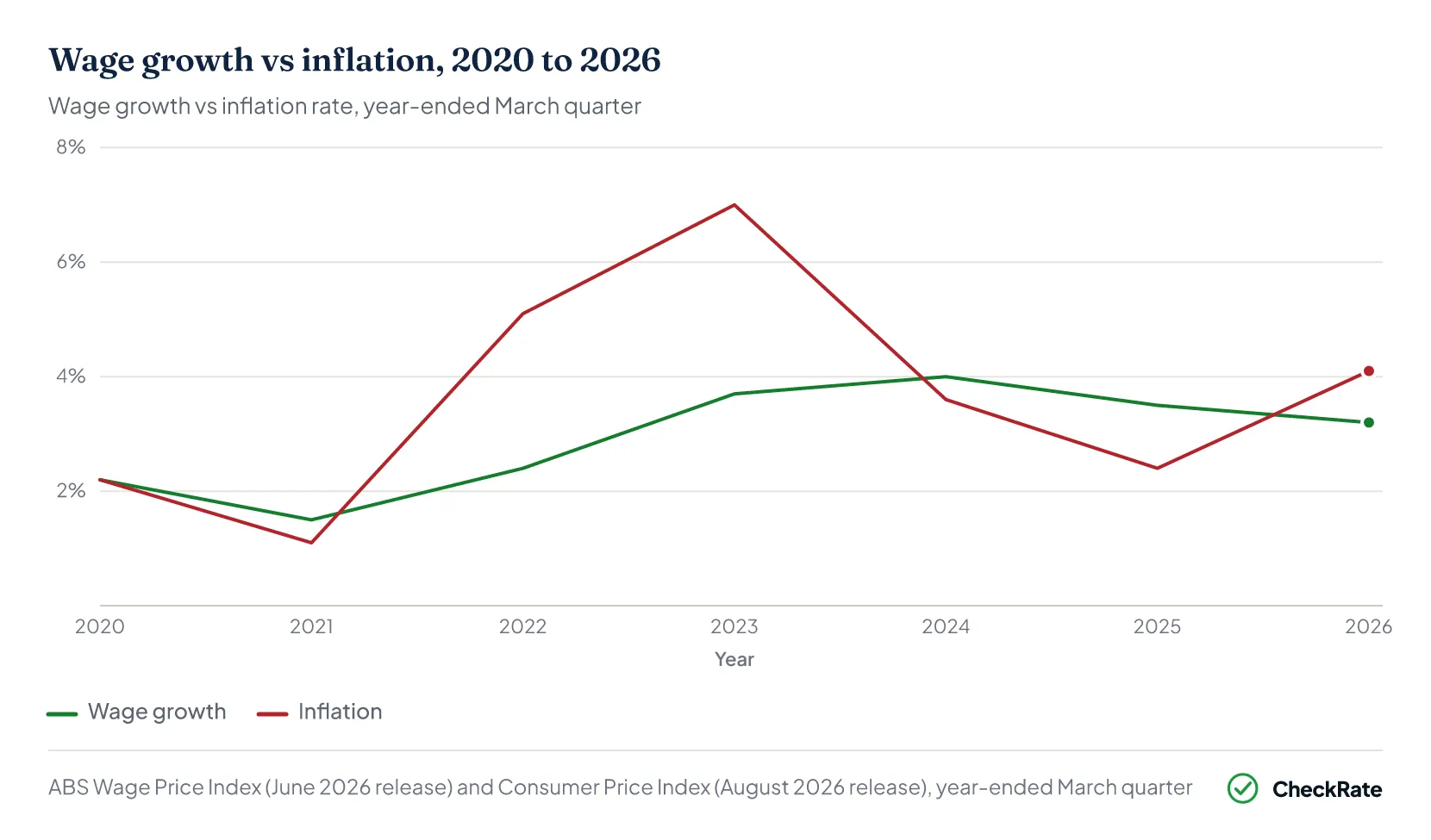
- 3.2%
- Year to June quarter 2026, below 3.9% inflation
- Job vacancies
- 325,000
- August 2026, down 0.9% on May 2026
 Average salary by occupation in AustraliaFull-time adult average weekly ordinary time earnings were $2,051.10 a week, or $106,657 a year, in November 2025. This is the main national benchmark for full-time adult earnings. It excludes overtim…
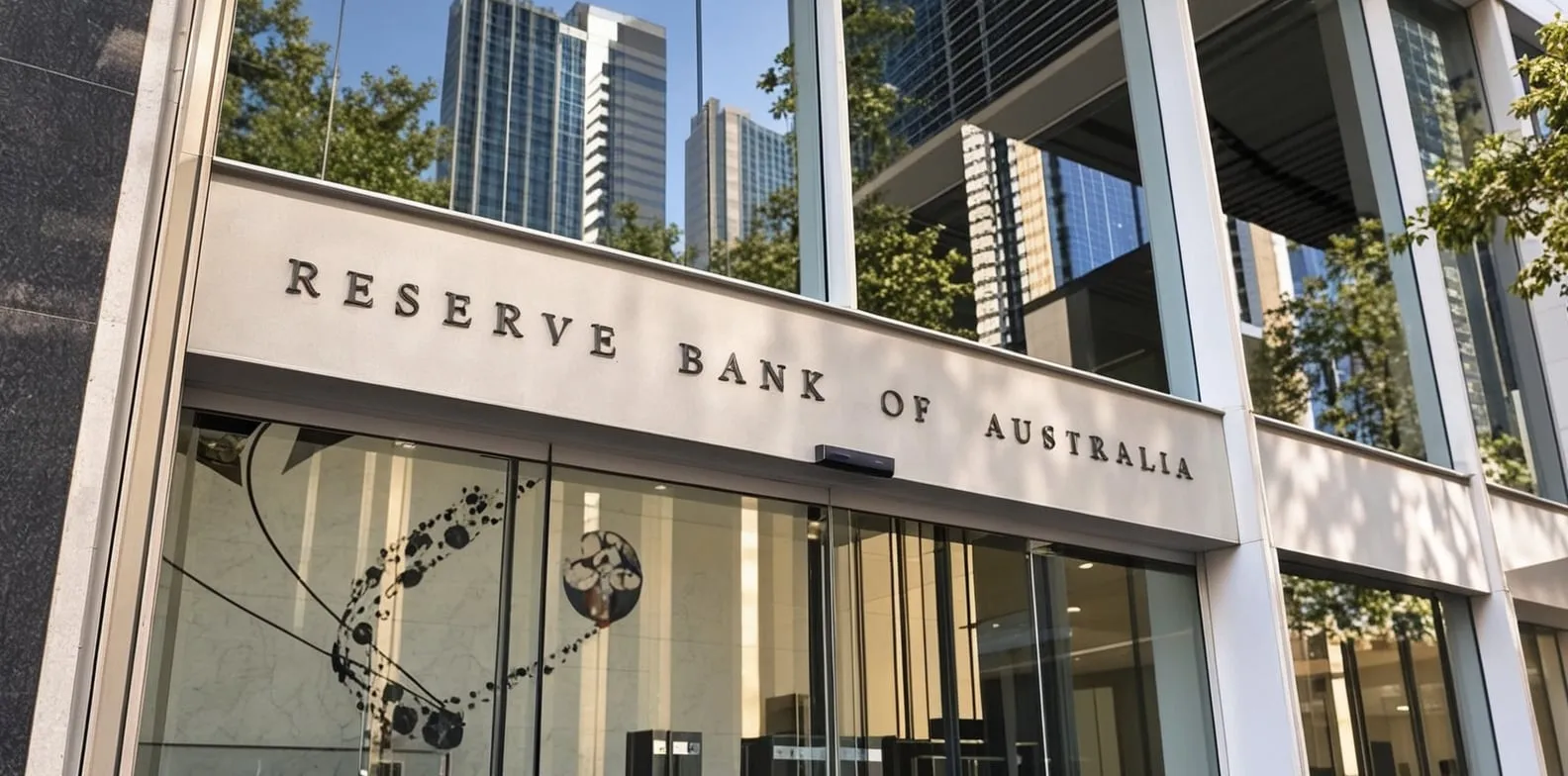 The RBA cash rate history: every change since 1990The Monetary Policy Board left the cash rate target unchanged at 4.35 per cent at its August 2026 meeting. The Board said financial conditions had tightened following three cash rate increases in 2026…
 Average salary in Australia 2026: wages, median pay and weekly earningsThe average full-time adult worker in Australia earned $2,051.10 per week in base pay, known as ordinary time earnings, as at November 2025. That is equal to $106,657 per year. This is the most widely…
Section 01 · The signal
What the job market says about the economy
Employment matters because it sits right at the centre of household life. For most people, wages, salaries or business income are what pay the rent, cover the mortgage, fill the trolley, keep the lights on and leave room for anything extra. When the job market is strong, households usually feel more secure. More people are working, fewer people are looking for work, and businesses may be competing for staff. That can support spending, confidence and wage growth.
However, a very tight job market can also create pressure. If businesses need to pay more to attract or keep workers, some will pass those higher costs on through prices. A weaker job market sends a different signal. If hiring slows, hours are cut, or unemployment rises, households may become more careful with money. Businesses may also delay investment, reduce staffing or prepare for softer demand.
Section 02 · Beyond the rate
A job is not always the same as enough work
Australia’s unemployment rate can look steady and still miss what many people are feeling in their week-to-week budget.
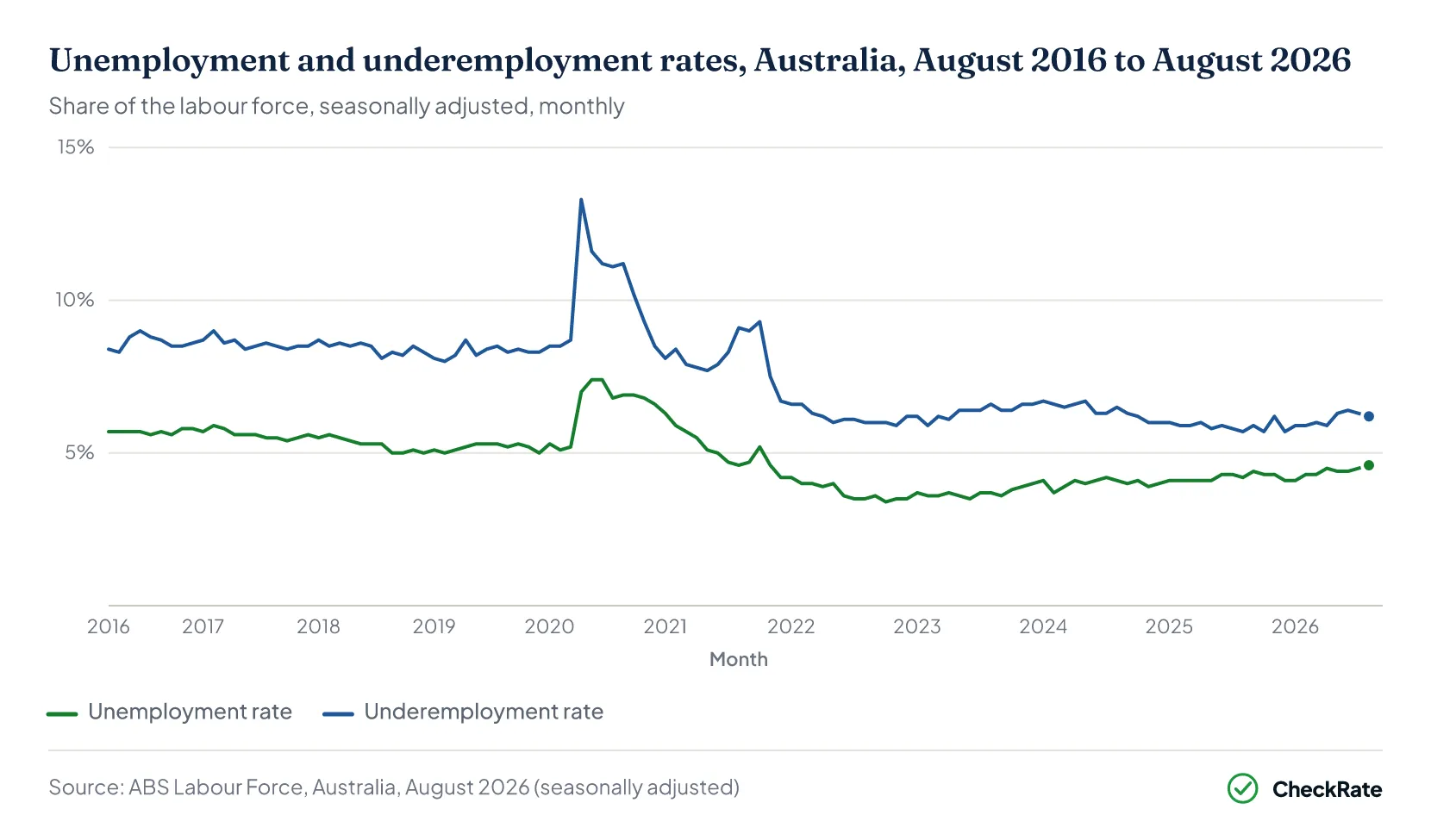
In August 2026, the unemployment rate rose to 4.6%, with around 14.8 million people employed.1 That is still lower than before the pandemic, though it is the highest rate since late 2021. But having a job does not always mean having enough hours, enough income, or enough confidence to spend freely.
That is where underemployment becomes important. In August 2026, the underemployment rate was 6.2%1, meaning some Australians had work but wanted more of it. For casual workers, contractors or people relying on shifts, that gap can matter more than the headline unemployment rate itself.
Hours worked add another layer. In August 2026, monthly hours worked increased to around 2,009 million hours in seasonally adjusted terms.1 When employment and hours are both rising, the labour market usually looks stronger than when jobs are growing but hours are flat.
The RBA looks beyond the unemployment figure alone. Hours worked, wages, job vacancies and workforce participation all help paint a clearer picture of whether the labour market is still holding up or whether pressure is starting to build beneath the surface.
Section 03 · Wages
Why wages are part of the employment story
A pay rise should make life feel easier. But if rent, groceries, insurance and energy bills are rising just as quickly, households can still feel under pressure.
Wages are an important part of the employment picture. They show whether people are gaining spending power or earning more on paper while everyday costs keep climbing.
For businesses, wage growth can tell a different story. Higher pay can help attract and keep staff, but it can also add to costs, especially for businesses already working on thin margins. Some absorb that pressure. Others may lift prices, slow hiring or delay investment.
The RBA watches wages closely because they can influence both household spending and business costs. Strong wage growth can support confidence and spending, but it can also add to inflation pressure if businesses start passing higher costs on to consumers.
Section 04 · Job security
How job security shapes household spending
Employment data is not only about how many people have jobs. It is also about how secure those jobs feel.
A household with steady work may feel comfortable planning ahead, booking a holiday, replacing the car, renovating, or simply saying yes to a few extra expenses. A household worried about job cuts, fewer shifts, or slower business may start pulling back before their income changes.
That caution can spread through the economy. If workers in one industry see hiring slow, they may spend less. If businesses notice customers becoming more careful, they may adjust staffing, stock levels or prices.
Employment is a useful signal for the RBA because it shows not only what people are earning now, but how confident they feel about the months ahead.
Section 05 · Industry differences
Not every industry feels the job market the same way
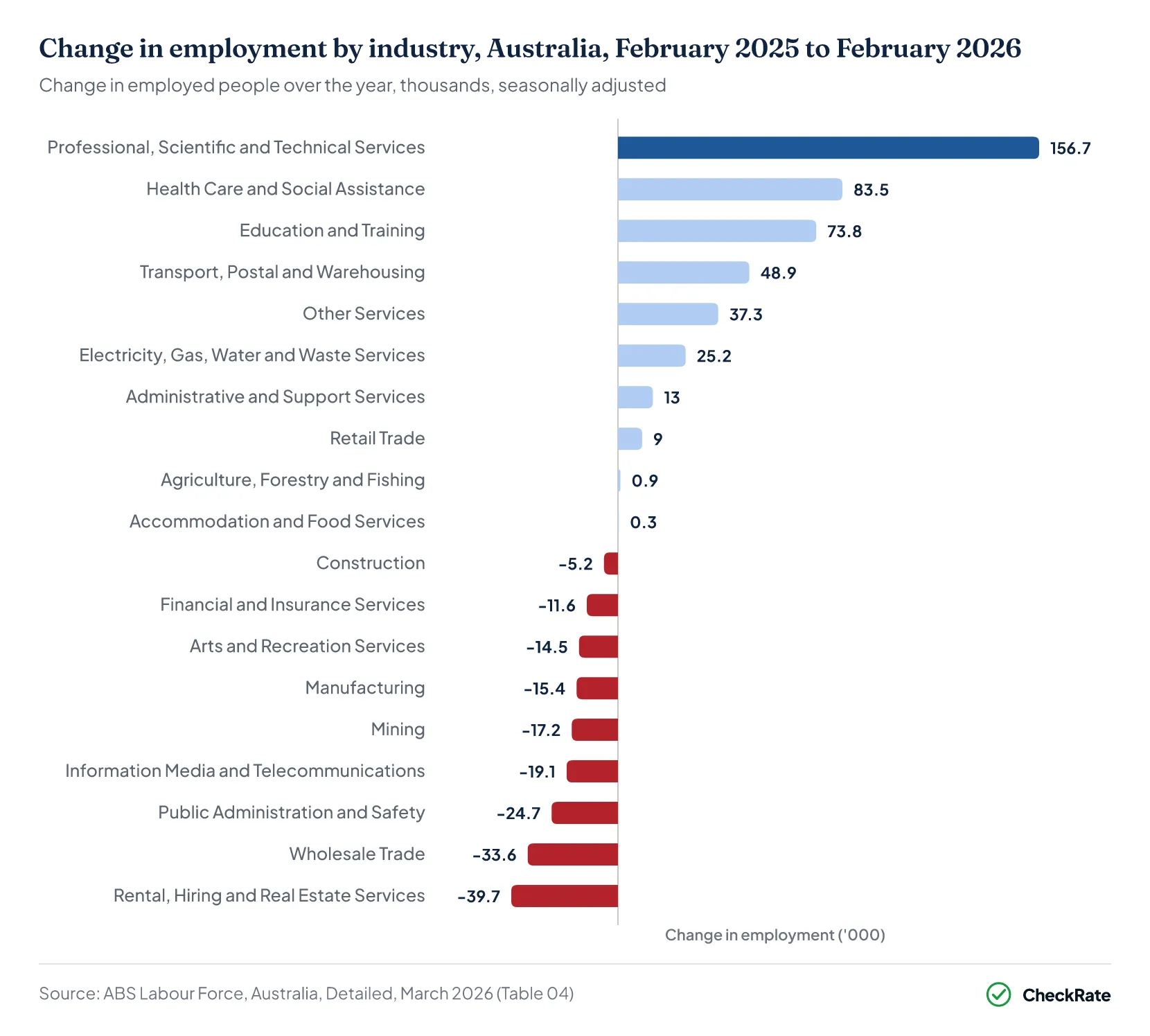
Australia can have one national unemployment rate, but very different job markets underneath it.
Some industries are shaped by long-term demand. Healthcare, aged care and education often move with population growth and service needs. Others can shift more quickly. Construction is affected by housing supply, infrastructure work, material costs and project delays. Retail and hospitality tend to feel changes in household spending sooner, while mining, agriculture and tourism can depend more heavily on regional conditions and global demand.
This means a national unemployment rate can hide very different local experiences. Some sectors may be hiring strongly while others slow down.
The headline numbers are useful, but they do not describe every workplace, every region or every household. For the RBA, the broader picture matters because strength in one part of the economy can sit alongside pressure somewhere else.
Section 06 · The RBA's read
Why jobs data matters before an RBA decision
By the time the RBA meets to decide on interest rates, it has already looked at far more than inflation alone. Employment is part of that picture because it helps show whether the economy still has momentum or is starting to lose speed.
A strong job market can support household spending, especially if wages and hours are also holding up. If inflation is still high at the same time, the RBA may see that as a sign that demand remains firm.
A softer job market can point in a different direction. If hiring slows, hours fall or unemployment starts to rise while inflation is easing, it may suggest households and businesses are already pulling back.
One jobs report will not decide a cash rate move on its own. Employment is one part of a wider picture that includes inflation, spending, wages, business conditions and global risks.
Section 07
The jobs indicators the RBA watches
| Indicator | Latest reading | What it tells the RBA |
|---|---|---|
| Unemployment rate | 4.6% (August 2026)1 | Rising unemployment suggests the economy is cooling and price pressure may ease. |
| Underemployment rate | 6.2% (August 2026)1 | Shows how many workers want more hours, a sign of spare capacity even when jobs are steady. |
| Participation rate | 67.1% (August 2026)1 | A high share of people working or looking for work adds to the supply of labour. |
| Wage growth (Wage Price Index) | 3.2% (year to June quarter 2026)2 | Faster pay growth can support spending but also lift business costs and prices. |
| Job vacancies | 325,000 (August 2026)5 | Shows how hard businesses are trying to hire; falling vacancies often come before slower jobs growth. |
Source · ABS Labour Force, Australia (August 2026); ABS Wage Price Index (June 2026); ABS Job Vacancies (August 2026). Seasonally adjusted.
Section 08 · The takeaway
The bottom line on employment
Employment is one of the most relatable economic indicators because it connects directly to people’s lives.
It shows whether Australians feel secure, whether wages are keeping up, whether businesses are still hiring, and whether households have enough confidence to keep spending.
For everyday Australians, that matters because interest rate decisions are not made in isolation. Inflation may get most of the attention, but the jobs market helps show how much pressure is sitting behind the numbers.
A steady labour market can suggest the economy still has momentum. A softer one can point to households and businesses becoming more cautious, often before that shift shows up more broadly across the economy.
References
- Australian Bureau of Statistics, Labour Force, Australia, August 2026 · Australian Bureau of Statistics ↑ b c d e f g
- ABS, Wage Price Index, Australia, June 2026 · Australian Bureau of Statistics ↑ b c
- ABS, Consumer Price Index, Australia, March 2026 · Australian Bureau of Statistics ↑ b
- ABS Labour Force, Australia, Detailed, Table 04, March 2026 · Australian Bureau of Statistics ↑
- ABS, Job Vacancies, Australia, August 2026 · Australian Bureau of Statistics ↑
- ABS Labour Force, Australia (latest release) · Australian Bureau of Statistics
- ABS Labour Force, Australia methodology, March 2026 · Australian Bureau of Statistics
- RBA Statement on Monetary Policy · Reserve Bank of Australia
- ABS, Consumer Price Index, Australia, June 2026 · Australian Bureau of Statistics