


Published
Section 01 · What it raises
How much revenue does the GST raise in Australia?
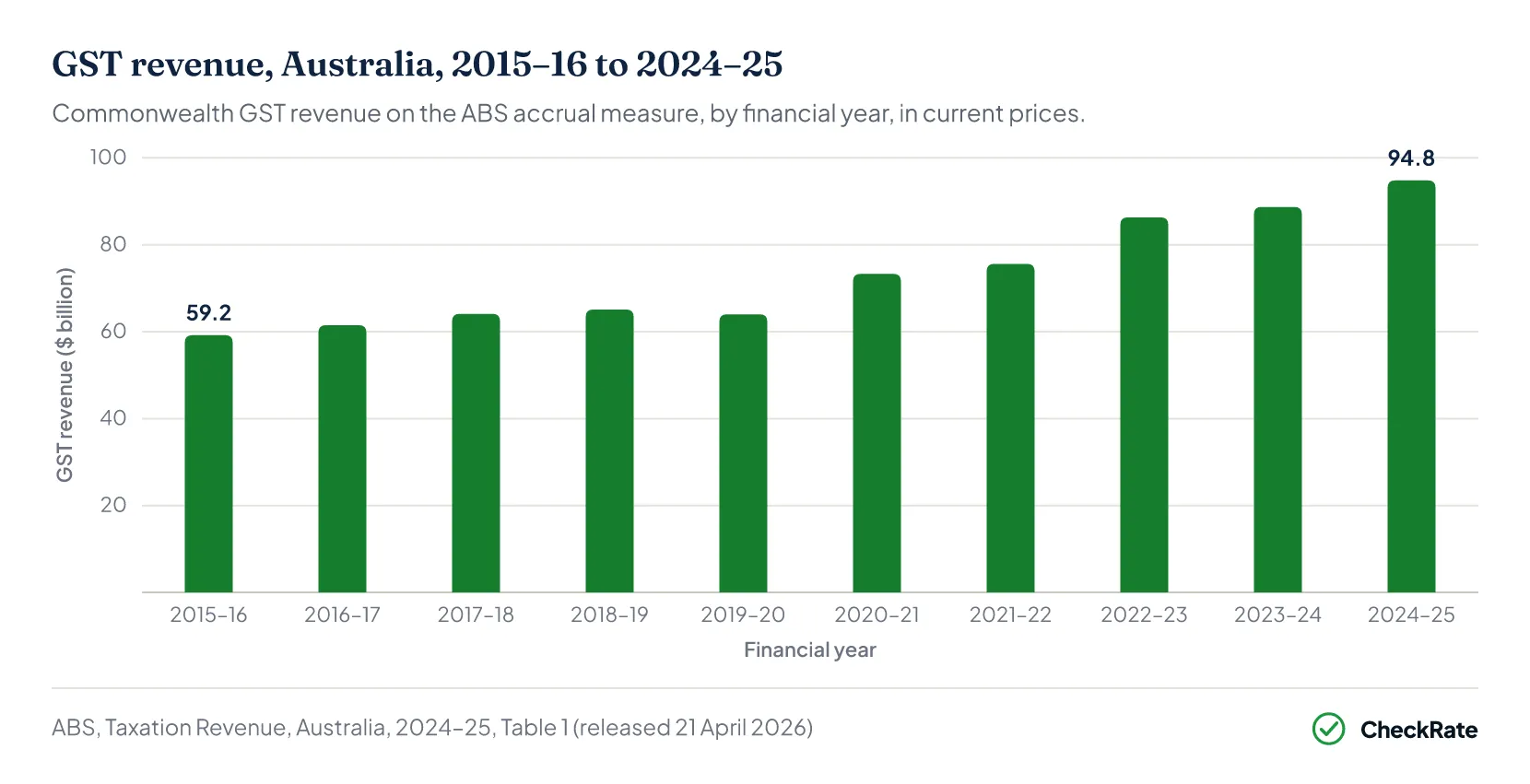
The GST raised $94.8 billion for the Commonwealth in 2024–25, on the accrual measure in the ABS government finance statistics. That was 14.0% of the Commonwealth's $675.2 billion of taxation revenue, derived by dividing $94,790 million by $675,173 million. It was also 11.3% of the $839.0 billion in taxation revenue recorded across all levels of government1.
The ATO describes the GST as a broad-based tax of 10% on most goods, services and other items sold or consumed in Australia. The rate is set by the A New Tax System (Goods and Services Tax) Act 1999, which fixes the amount of GST on a taxable supply at 10% of the value of the supply, and it has applied at that rate since the tax began on 1 July 20002.
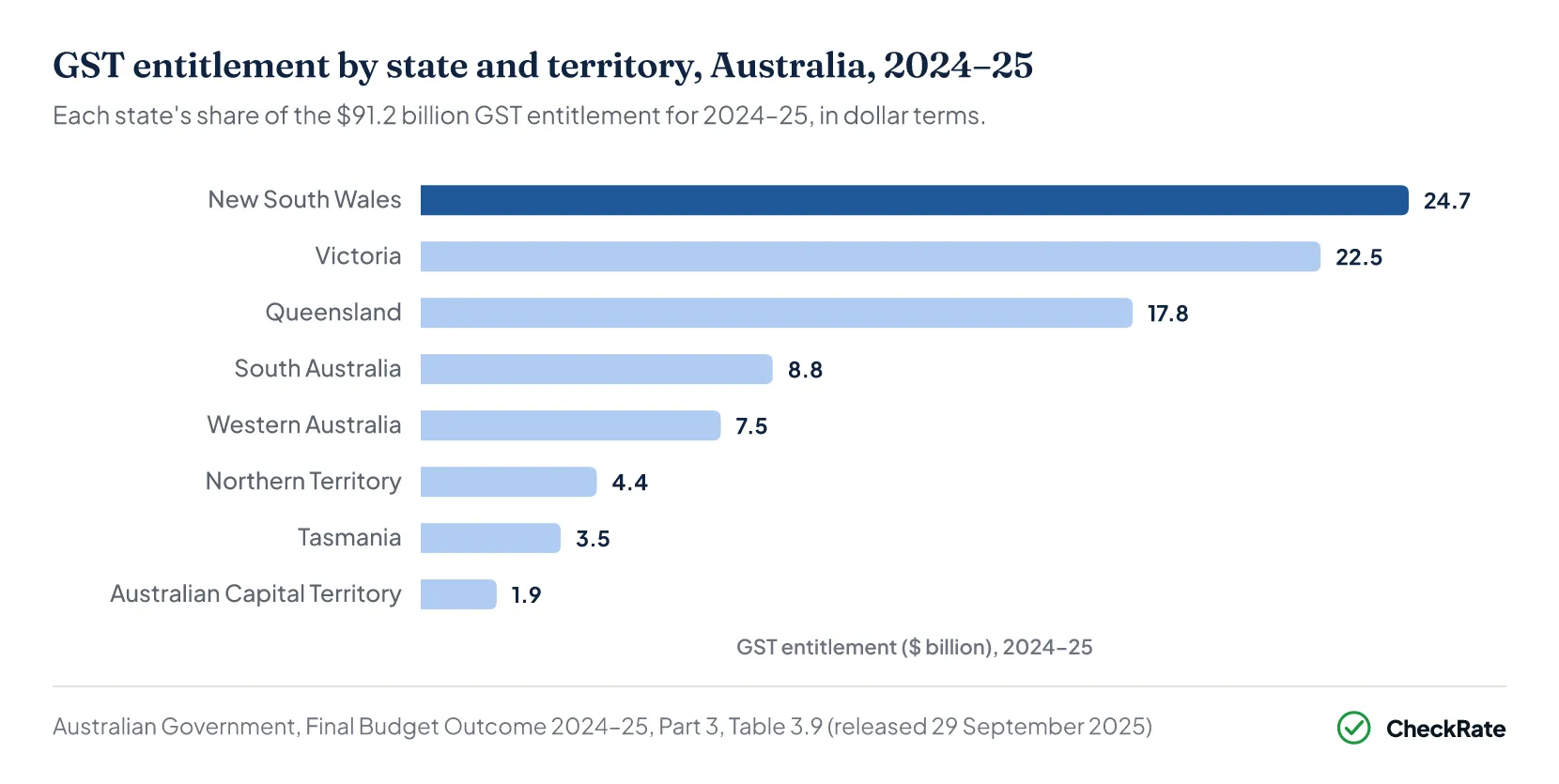
On the cash measure, the ATO collected $90.2 billion of net GST in 2024–25, including $5.6 billion collected on imports by the Department of Home Affairs3. The states and territories had a combined GST entitlement of $91.2 billion for the year. The totals differ because each publication measures a different point in the tax flow, from the liabilities that accrued on sales to the cash collections and the final state and territory entitlement.
Section 02 · Since 2000
How GST revenue has changed since 2000
GST revenue was $23.9 billion in 2000–01, the first full year of the tax. By 2024–25 it had risen to $94.8 billion, about four times the first-year amount. The two figures come from different issues of the same ABS publication, which shows ten years per issue. The 2000–01 figure comes from the 2009–10 issue and has not been republished since4.
In the latest ABS release, which covers 2015–16 to 2024–25, GST revenue increased from $59.2 billion to $94.8 billion, an increase of $35.6 billion or 60% over the nine years. Revenue fell only once in that period, from $65.1 billion in 2018–19 to $64.0 billion in 2019–201. On the ATO's cash measure, the 2024–25 outcome was 6.2%, or $5.3 billion, higher than in 2023–24. The ATO attributed the increase to growth in consumption subject to GST over the year3.
Not all GST that is owed is collected. The ATO estimated the net GST gap, which measures the difference between GST collected and the amount that would have been collected if all taxpayers were fully compliant, at $8.7 billion in 2023–24. This was equivalent to 9.4% of theoretical GST. The estimated gap increased from $8.1 billion and 9.1% in 2022–233.
Section 03 · Three categories
Which goods and services are taxable, GST-free or input taxed?
Sales by a GST-registered business fall into three categories: taxable, GST-free or input taxed. A taxable sale carries 10% GST in its price, and the seller can claim credits for the GST on the inputs used to make it. The GST Act's GST-free categories include food, health, education and child care, under Subdivisions 38-A to 38-D of the Act; its input-taxed categories include financial supplies and residential rent, under Division 402.
GST-free and input-taxed sales both have no GST added to the sale price, but their treatment differs for the seller. A business makes a GST-free sale without charging GST and can still claim credits for the GST included in the price of purchases used to make that sale. ATO guidance lists most basic foods, some education courses and some medical, health and care products and services as GST-free5. A business making an input-taxed sale also charges no GST, but generally cannot claim credits on purchases used to make that sale. Common input-taxed sales are financial supplies, such as lending money, and selling or renting out residential premises6.
| The three GST categories of sales, Australia | |||
|---|---|---|---|
| Category | GST on the sale | Credits for GST on inputs | Main examples |
| Taxable | 10% included in the price | Can be claimed | Most goods, services and other items sold or consumed in Australia |
| GST-free | None | Can be claimed | Most basic foods, some education courses, some medical, health and care products and services, child care |
| Input taxed | None | Cannot be claimed | Financial supplies, selling or renting out residential premises |
Source · Categories and examples per ATO guidance (GST-free sales, QC22422; Input-taxed sales, QC22425) and Divisions 38 and 40 of the A New Tax System (Goods and Services Tax) Act 1999.
Section 04 · Collection mechanics
How businesses collect GST and claim input tax credits
GST is collected by registered businesses, not by the ATO at the point of sale. The registration threshold depends on the type of business or activity. A business must register once its GST turnover is $75,000 or more. A non-profit organisation must register once its GST turnover reaches $150,000 or more. Businesses providing taxi or limousine travel for passengers, including ride-sourcing, must register regardless of turnover. Registration is required within 21 days of becoming liable7.
A registered business includes GST in the price of its taxable sales and claims credits, which the ATO calls GST credits or input tax credits, for the GST included in eligible business purchases. Both amounts are reported on the business activity statement, and the credits are offset against the GST the business is liable to pay. Because the rate is 10% of a sale's value, the GST component of a GST-inclusive price is one eleventh of that price. A tax invoice is needed to claim a credit on purchases that cost more than $82.508.
In the ATO's example, a business that reports GST monthly on a cash basis buys equipment for $6,600 including GST, paid in three monthly instalments of $2,200. Each instalment includes $200 in GST credits, which is one eleventh of the payment. The business cannot claim in the first month because it does not yet hold a tax invoice. When the invoice arrives in the second month, the business claims $400 covering the first two payments, and the final $200 in the month of the last payment8.
Section 05 · State shares
How GST revenue is distributed among the states and territories
GST revenue is distributed among the states and territories using population shares and revenue-sharing relativities. Under section 5 of the Federal Financial Relations Act 2009, each state is entitled to a grant worked out from the GST pool and its population share, adjusted by a relativity factor. In 2024–25, the combined GST entitlement of states and territories was $91.2 billion, including a pool top-up of $981 million. The Australian Government has added $600 million a year into the pool since 2021–22, growing with the pool, and added a further $250 million in 2024–25. The entitlement is based on cash receipts rather than accrual revenue. The Final Budget Outcome reconciles $96.5 billion of accrual GST revenue to $90.3 billion of cash receipts, subtracts small penalty and agency adjustments, and adds the $981 million top-up to reach $91.2 billion9.
The shares are not equal per person. The Australian Government distributes the GST on revenue-sharing relativities recommended by the Commonwealth Grants Commission, with the Treasurer issuing a determination each year. The commission's objective is to give each state and territory the financial capacity to provide services at a comparable standard if each made the same effort to raise revenue10. A relativity above 1 gives a state or territory more than its equal per-person share. In the commission's 2026 Update, the Northern Territory's recommended relativity for 2026–27 is 5.24149, the highest of the eight. New South Wales and Western Australia have the lowest recommended relativities, both at 0.81964. The commission estimated a GST pool of $102.5 billion for distribution in 2026–27.
| GST revenue sharing relativities recommended by the Commonwealth Grants Commission | ||
|---|---|---|
| State or territory | 2025–26 | 2026–27 (recommended) |
| New South Wales | 0.86034 | 0.81964 |
| Victoria | 1.06722 | 1.05742 |
| Queensland | 0.84571 | 0.87237 |
| Western Australia | 0.75000 | 0.81964 |
| South Australia | 1.38876 | 1.35920 |
| Tasmania | 1.84053 | 1.88285 |
| Australian Capital Territory | 1.17223 | 1.16179 |
| Northern Territory | 5.15112 | 5.24149 |
Source · Commonwealth Grants Commission, 2026 Update, GST Relativities 2026–27, released 13 March 2026.
Section 06 · World rates
How Australia's 10% GST rate compares with overseas VAT and GST rates
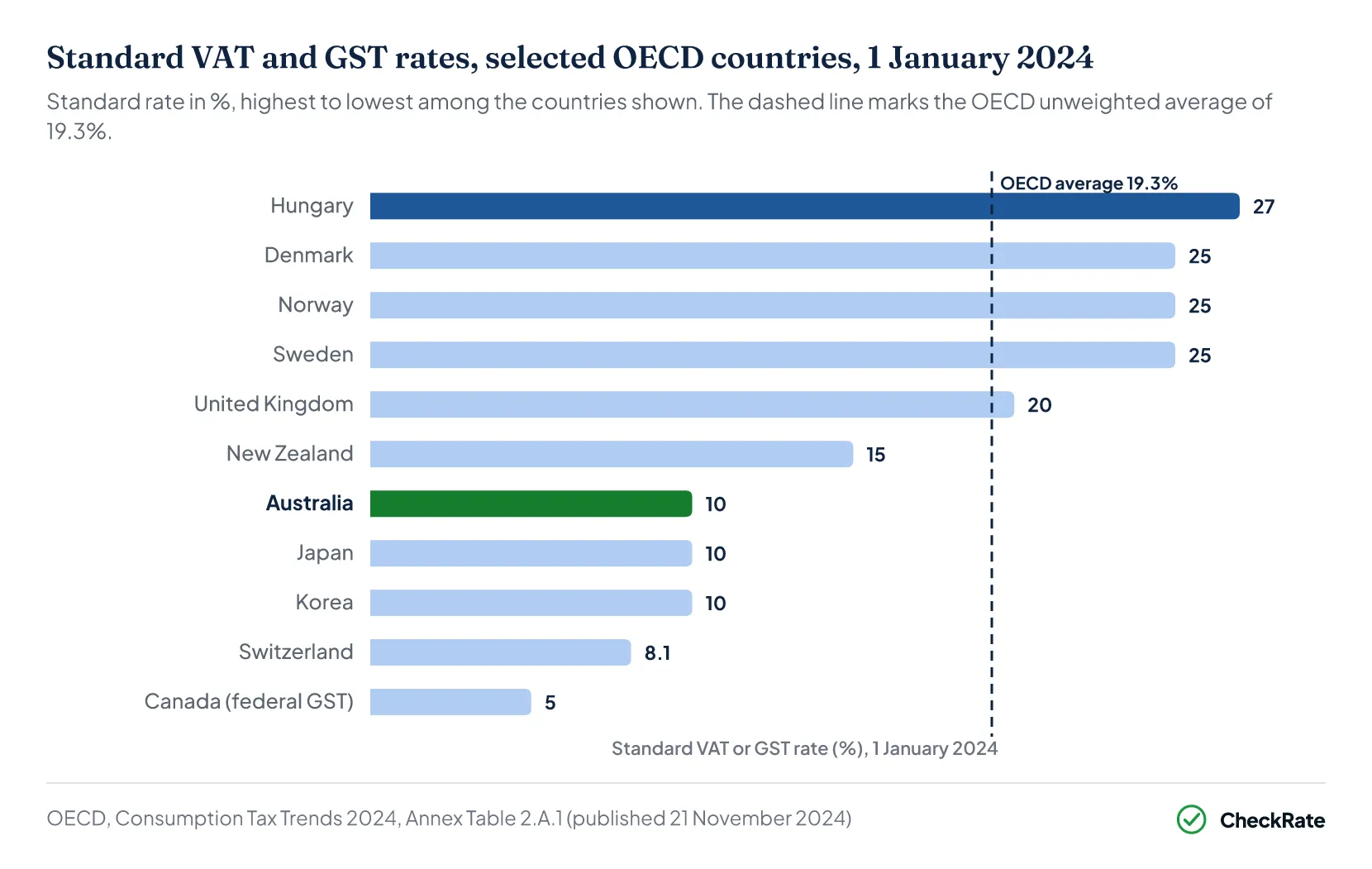
Australia's 10% GST rate is one of the lowest standard VAT or GST rates in the OECD. Value-added taxes operate in 37 of the 38 OECD countries, with the United States the only member without one. The unweighted average standard rate across the 37 countries with a VAT or GST was 19.3% at 1 January 2024. Only Canada's 5% federal GST and Switzerland's 8.1% rate were lower than Australia's. Japan and Korea also had standard rates of 10%. Hungary had the highest standard rate at 27%11.
The comparison is a snapshot as at 1 January 2024, and some rates have since changed. The same report records that Estonia's standard rate rose from 20% to 22% at the start of 202411, and that Finland's rate, shown at 24% in the table, increased to 25.5% on 1 September 2024.
Australia's rate has remained 10% since the tax began. The OECD also compares registration thresholds. Australia's $75,000 threshold, equivalent to about USD 54,000 at purchasing power parity, falls within the report's band of seven countries with thresholds between USD 40,000 and USD 80,000. Twelve OECD countries had thresholds above USD 80,00011.
Australia
Standard GST rate 10%, unchanged since 1 July 2000
Registration threshold $75,000, about USD 54,000 at purchasing power parity
GST began 1 July 2000
OECD
Average standard VAT/GST rate 19.3%, as at 1 January 2024
Twelve members' thresholds above USD 80,000; seven, including Australia, between USD 40,000 and USD 80,000
VAT operates in 37 of 38 member countries
Source · GST Act s 9-70; OECD, Consumption Tax Trends 2024, Annex Tables 2.A.1 and 2.A.5
Section 07 · Three taxes
How GST revenue compares with income tax and company tax
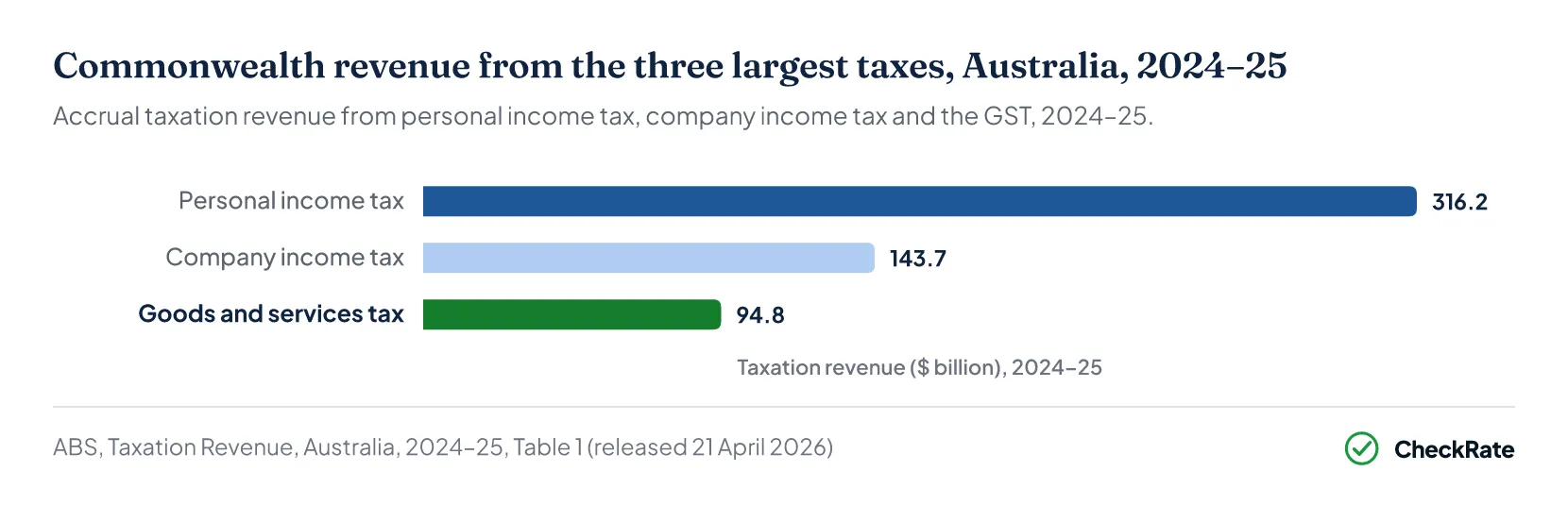
The GST raised the third-largest amount of any single Commonwealth tax in 2024–25. Personal income tax raised $316.2 billion and company income tax $143.7 billion, against the GST's $94.8 billion, all on the same ABS accrual measure. No other single Commonwealth tax raised more than $26.1 billion. Personal income tax alone raised about 3.3 times as much as the GST1. As shares of the Commonwealth's $675.2 billion of taxation revenue, personal income tax accounted for 46.8%, company income tax 21.3% and the GST 14.0%, each derived from the same table.
The gap has widened since 2015–16. Between 2015–16 and 2024–25, using the consistent series in the latest ABS release, personal income tax revenue increased by $143.0 billion or 83% and company income tax by $79.3 billion or 123%. GST revenue increased by $35.6 billion or 60%. GST revenue grew more slowly than either income tax over that period1.
How company tax collections are split by rate, industry and company size is covered in the company tax statistics article.
Section 08 · The base
What exemptions and concessions mean for the GST base
GST exemptions and concessions keep some consumption outside the tax base, and Treasury estimates the resulting revenue forgone. In Treasury's 2025–26 Tax Expenditures and Insights Statement, the estimated revenue forgone in 2024–25 from GST-free food was $9.5 billion, the largest GST item in the statement. GST-free medical and health services were estimated at $6.3 billion and education at $4.2 billion. Across food, education and the five health-related GST-free items listed in the statement, the estimated revenue forgone was $22,985 million. That was about 24% of GST revenue on the ABS measure for 2024–25, derived by dividing $22,985 million by $94,790 million12. These are estimates of revenue forgone, not amounts collected, and they assume behaviour would not change if the exemptions ended.
The input-taxed treatment of financial supplies is also counted as a concession, with an estimated $3.7 billion of revenue forgone in 2024–25. GST-free child care services and water and sewerage accounted for a further $2.4 billion and $1.3 billion respectively. Treasury rates most of these estimates as having medium reliability. The medical aids estimate is rated low, and the financial supplies and child care estimates medium to low. Residential rent also carries no GST, because renting out residential premises is input taxed. The statement treats residential rent as part of the GST benchmark rather than a concession, so it publishes no revenue-forgone estimate for it12.
The OECD's VAT revenue ratio measures the VAT actually collected against the amount that would be collected if the standard rate applied to all final consumption expenditure. Australia's ratio was 0.50 in 2022, the latest year published by the OECD, compared with an OECD unweighted average of 0.58; New Zealand recorded 0.96. The OECD states that the ratio combines the effect of exemptions and reduced rates, fraud, evasion and tax planning. It therefore measures the overall gap between the theoretical and actual VAT base, rather than the exemptions alone11.
| Estimated revenue forgone from GST concessions, Australia, 2024–25 | ||
|---|---|---|
| Concession | Estimated revenue forgone ($m) | Estimate reliability |
| Food (GST-free) | 9,500 | Medium |
| Medical and health services (GST-free) | 6,300 | Medium |
| Education (GST-free) | 4,150 | Medium |
| Financial supplies, input-taxed treatment | 3,650 | Medium to low |
| Child care services (GST-free) | 2,440 | Medium to low |
| Residential care, community care and other care services (GST-free) | 1,690 | Medium |
| Water, sewerage and drainage (GST-free) | 1,330 | Medium |
| Financial supplies, reduced input tax credits | 900 | Medium to low |
| Drugs and medicinal preparations (GST-free) | 540 | Medium |
| Private health insurance (GST-free) | 510 | Medium |
| Medical aids and appliances (GST-free) | 295 | Low |
Source · Treasury, 2025–26 Tax Expenditures and Insights Statement, published 17 December 2025.
Section 09
GST statistics: quick answers
How much GST does Australia collect each year?
The GST raised $94.8 billion in 2024–25 on the ABS accrual measure of Commonwealth taxation revenue. On a cash basis the ATO collected $90.2 billion of net GST in the same year, and the combined GST entitlement of the states and territories was $91.2 billion. The three figures measure the same tax in different ways.
What is the GST rate in Australia?
The GST rate in Australia is 10%. The A New Tax System (Goods and Services Tax) Act 1999 sets the amount of GST on a taxable supply at 10% of its value, and the rate has not changed since the tax began on 1 July 2000.
Who gets the GST revenue in Australia?
The states and territories receive the GST revenue. Under section 5 of the Federal Financial Relations Act 2009, each state and territory receives a grant based on the GST pool and its population share and a revenue-sharing relativity. For 2024–25 the combined GST entitlement was $91.2 billion, including a $981 million pool top-up, and the shares were based on relativities recommended by the Commonwealth Grants Commission.
What is GST-free in Australia?
GST-free sales carry no GST in the price, and the seller can still claim credits for the GST on its inputs. The GST Act's GST-free categories include food, health, education and child care, and ATO guidance lists most basic foods, some education courses and some medical, health and care products and services as GST-free. Treasury estimated the revenue forgone from GST-free food, health and education at $22,985 million in 2024–25.
Who has to register for GST?
A business must register for GST when its GST turnover is $75,000 or more. A non-profit organisation must register when its GST turnover reaches $150,000 or more. Businesses providing taxi or limousine travel for passengers, including ride-sourcing, must register regardless of turnover. Registration is required within 21 days of becoming liable, under ATO guidance.
Is Australia's GST high or low compared with other countries?
Australia's 10% GST is one of the lowest standard rates in the OECD. Among the 37 OECD countries that levy a VAT or GST, the unweighted average standard rate was 19.3% as at 1 January 2024. Only Canada's 5% federal GST and Switzerland's 8.1% standard rate were lower than Australia's rate, and Japan and Korea also had standard rates of 10%.
References
- ABS, Taxation Revenue, Australia, 2024–25, Table 1 · Australian Bureau of Statistics ↑ b c d
- A New Tax System (Goods and Services Tax) Act 1999 (compilation C2026C00081) · legislation.gov.au ↑ b
- ATO, GST administration annual performance report 2024–25, 2. GST revenue performance (QC105962) · ato.gov.au ↑ b c
- ABS, Taxation Revenue, Australia, 2009–10 issue, Table 1 (data cube) · Australian Bureau of Statistics ↑
- ATO, GST-free sales (QC22422) · ato.gov.au ↑
- ATO, Input-taxed sales (QC22425) · ato.gov.au ↑
- ATO, Registering for GST (QC22412) · ato.gov.au ↑
- ATO, When you can claim a GST credit (QC22431) · ato.gov.au ↑ b
- Australian Government, Final Budget Outcome 2024–25, Part 3: Australia's Federal Financial Relations · archive.budget.gov.au ↑
- Commonwealth Grants Commission, 2026 Update: GST Relativities 2026–27 · cgc.gov.au ↑
- OECD, Consumption Tax Trends 2024 · oecd.org ↑ b c d
- Treasury, 2025–26 Tax Expenditures and Insights Statement · treasury.gov.au ↑ b
- ATO, How GST works (QC22411) · ato.gov.au
- Federal Financial Relations Act 2009 (compilation C2024C00843) · legislation.gov.au